How to remove sun tan from face naturally: 10 Home Remedies (Dermatologist Verified)
Updated on: September 30, 2026 | Medically reviewed by: Dr. Bhanu Pratap Singh
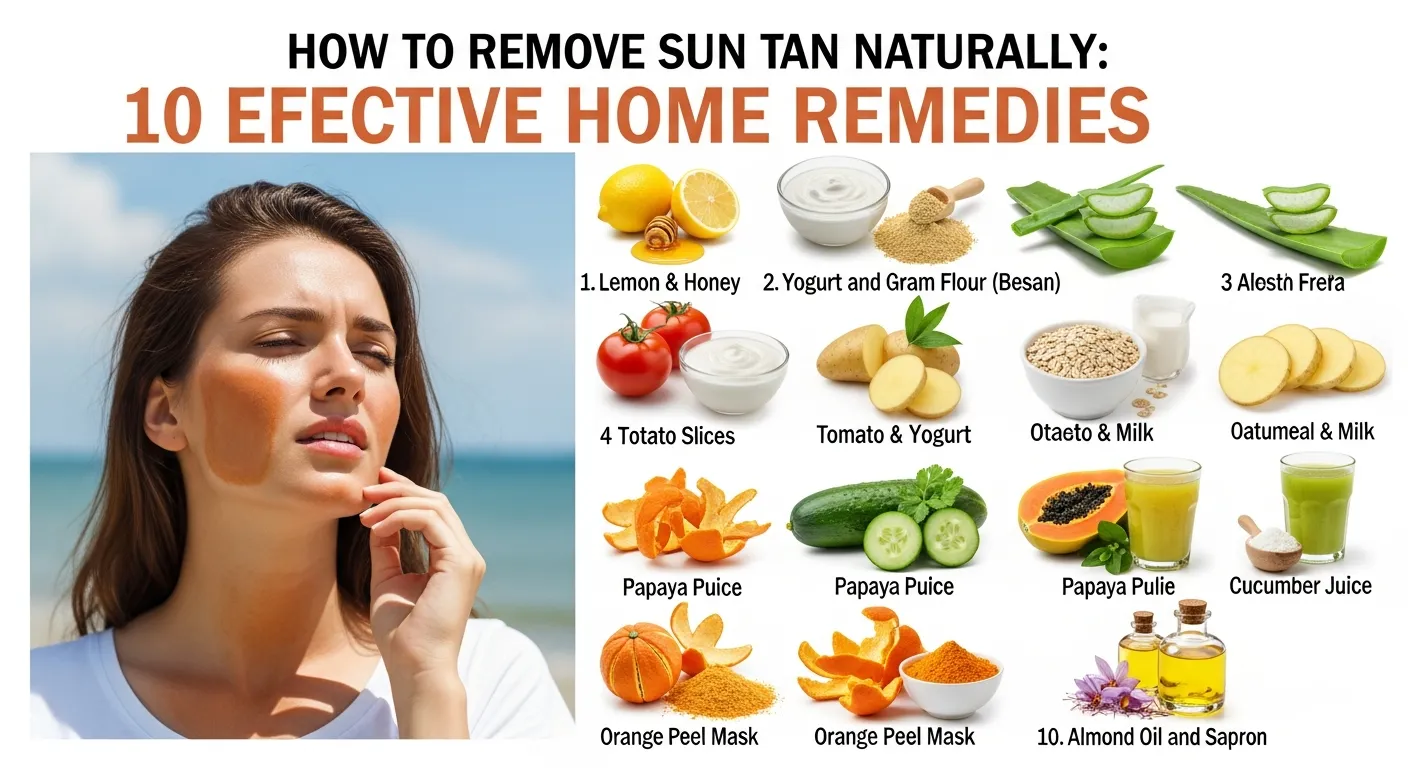
Looking for the fastest tan removal home remedies that actually work? Whether you want to remove sun tan in 5 minutes before an event, or gradually lighten a deep tan overnight, this guide covers it all. Learn how to remove sun tan from face, neck, and body naturally using besan, tomato, lemon, and 7 more ingredients found in every Indian kitchen.
Introduction: What Is Sun Tan and Why Does It Happen?
Living in a country like India, the sun is a constant companion. Whether you are a college student travelling by bus, a farmer working in the fields, or simply someone stepping out to buy vegetables, the harsh rays of the sun affect everyone. You might notice that after spending a few hours outside, your skin looks darker, dull, or uneven. This is what we call a "Sun Tan."
But why does this happen? To understand tanning, think of your skin like a house. When the sun beats down on the roof, it gets hot. Your body has a natural defense system to protect the inside of the house (your cells) from burning. This defense system is a pigment called Melanin.
Imagine Melanin as tiny soldiers holding umbrellas. When the sun's rays hit your skin, your body sends a signal to produce more Melanin soldiers to open their umbrellas and shield your skin cells from damage. The darker your skin gets, the more soldiers have arrived to protect you. So, a tan is actually a sign that your skin is trying to save itself from burning.
However, while this process protects you, it leaves behind a layer of dark, dull skin that can take weeks or months to fade on its own. This guide will explain how to speed up that process using simple, natural ingredients found in almost every Indian kitchen.
🌟 Quick Summary: Best Tan Removal Home Remedies by Goal
- ✅ Remove tan in 5 minutes: Tomato + Sugar Ice Cube Rub
- ✅ Remove tan overnight: Aloe Vera Gel (overnight mask)
- ✅ Fastest sun tan removal: Lemon Juice & Honey Pack
- ✅ For glowing skin: Curd & Gram Flour (Besan Ubtan)
- ✅ For sunburn relief: Fresh Aloe Vera Gel
- ✅ For oily skin tanning: Multani Mitti & Rose Water
- ✅ For deep exfoliation: Coffee & Coconut Oil Scrub (new)
Keep reading for step-by-step methods to remove tan from face naturally — including a skin-type wise comparison table.
Common Causes of Sun Tan on Face
The primary cause of tanning is exposure to Ultraviolet (UV) radiation from the sun. However, it is important to understand the details to prevent it effectively.
1. UVA vs. UVB Rays
Sunlight contains two main types of harmful rays that reach the earth:
- UVA Rays (The Aging Rays): These rays go deep into the skin. They are responsible for long-term damage like wrinkles and premature aging. They are present throughout the day, even when it is cloudy.
- UVB Rays (The Burning Rays): These affect the top layer of the skin. They are strongest between 10:00 AM and 4:00 PM. These are the main culprits behind tanning and sunburns.
2. Duration of Exposure
In India, the sun is very strong. Spending even 15 to 20 minutes under direct sunlight without protection can trigger the production of melanin. For those with sensitive skin, this time can be even shorter.
3. Lack of Protection
Walking outside without a hat, scarf, or sunscreen leaves the facial skin completely vulnerable. The face is the most exposed part of the body, which is why it tans faster than arms or legs.
Types of Sun Tan (Mild, Moderate & Severe)
Not all tans are the same. Understanding the severity helps in choosing the right remedy.
Mild Tan
- Appearance: Slight darkening of the skin, usually visible when you remove your watch or spectacles.
- Cause: Short exposure to morning or evening sun.
- Recovery: Fades easily with basic care in a few days.
Moderate Tan
- Appearance: Distinct dark patches. The skin may look dull and feel slightly dry.
- Cause: Spending 1-2 hours in the afternoon sun.
- Recovery: Requires consistent home remedies and exfoliation (scrubbing) to remove.
Severe Tan (Sunburn)
- Appearance: The skin is very dark, red, painful, or peeling. It feels hot to the touch.
- Cause: Prolonged exposure during peak heat (e.g., a day at the beach or working in fields all day).
- Recovery: This is actual damage to the skin. It requires cooling, medical attention, and time before you can try scrubbing it.
Which Tan Removal Remedy Is Best for You? (Quick Reference Table)
Not sure which remedy to try first? Use this table to pick the right one based on your skin type and goal:
| Remedy | Best For | Skin Type | Time Needed | Speed |
|---|---|---|---|---|
| Lemon + Honey | Bleaching dark spots | Normal / Oily | 20 min | ⚡ Fast |
| Aloe Vera Gel | Sunburn + overnight repair | All types | Overnight | 🌙 Overnight |
| Besan + Curd (Ubtan) | Glowing skin + exfoliation | All types | 20 min | ⚡ Fast |
| Tomato Pulp | Quick glow, pigmentation | Oily / Combination | 15–20 min | ⚡ Fast |
| Potato Juice | Dark spots + dark circles | Sensitive / All | 20 min | ⚡ Fast |
| Sandalwood | Soothing + brightening | Sensitive / Dry | 15–20 min | 🕐 Gradual |
| Cucumber Juice | Irritated / itchy skin | Sensitive | 20 min | 🕐 Gradual |
| Multani Mitti | Deep cleansing + oiliness | Oily | 20 min | ⚡ Fast |
| Papaya Pulp | Enzyme exfoliation + glow | Normal / Dry | 15 min | ⚡ Fast |
| Malai (Milk Cream) | Dry, flaky tanned skin | Dry | 20 min | 🕐 Gradual |
| Coffee + Coconut Oil | Body tan, deep scrub | Normal / Oily | 5–10 min | ⚡ Fast |
How to Remove Sun Tan from Face, Neck & Body Naturally: 11 Proven Home Remedies
Nature provides us with powerful ingredients that can gently bleach dark spots and remove dead skin cells. Here are 11 dermatologist-backed methods tailored specifically for Indian skin types and climate.
1. Lemon Juice and Honey
Lemon is one of the most famous natural cleaners. It contains Citric Acid, which acts like a mild bleach. However, lemon alone can be too harsh and dry out the face. This is why we add honey.
- How it Works: Lemon cuts through the dark pigment, while honey acts as a moisturizer, keeping the skin soft. Honey is also antibacterial, which helps if you have pimples.
- Preparation: Squeeze one fresh lemon into a bowl. Add one tablespoon of honey. Mix well.
- Application: Apply to the face using your fingers or a cotton ball. Leave it for 20 minutes. You might feel a slight tingling; this is normal.
- Rinse: Wash with lukewarm water.
- Important: Do not go out in the sun immediately after using lemon, as it makes your skin sensitive to light.
Lemon juice increases photosensitivity. Always apply this pack at night, and never step into direct sunlight for at least 4 hours after use. If you have sensitive skin, dilute lemon juice with equal parts rose water before applying.
2. Aloe Vera Gel
Aloe Vera is often called the "miracle plant." It is grown in pots in many Indian households. It is filled with water and soothing compounds.
- How it Works: Aloe Vera contains Aloin, a compound that naturally depigments dark skin patches. It is also extremely cooling, which helps if your tan feels hot or burning.
- Preparation: Cut a fresh leaf from the plant. Slice it open and scrape out the clear jelly-like substance. You can also use store-bought gel if it is 100% natural.
- Application: Apply a thick layer over the face before going to bed.
- Rinse: Wash it off in the morning. It acts as an overnight mask.
Aloe Vera is the safest remedy for daily use and even for those with active acne. For a faster result, mix it with a few drops of Vitamin E oil before applying overnight. It is the best choice for sunburn cases — cool the skin first, then apply.
3. Curd and Gram Flour (Besan Ubtan)
This is perhaps the oldest skincare trick in India, used by grandmothers for generations. It is also known as "Ubtan."
- How it Works: Besan (Gram Flour) is an excellent scrubber. It removes dead skin cells without scratching the face. Curd contains Lactic Acid, which gently dissolves the glue holding dead, dark skin cells together.
- Preparation: Mix two spoons of Besan with one spoon of sour curd. Add a pinch of turmeric (haldi) for antiseptic benefits.
- Application: Apply the paste to your face and neck. Let it dry for about 20 minutes.
- Rinse: Wet your hands and gently rub the dried paste off in circular motions. Then wash with water.
This Ubtan is the most recommended remedy for Indian skin because it suits all skin types and addresses both tanning and dullness simultaneously. Use it 3 times a week for visible results within 10 days. People with active acne should skip the turmeric and use plain besan + curd only.
4. Tomato Pulp
Tomatoes are not just for curry; they are excellent for the skin.
- How it Works: Tomatoes are rich in Lycopene, an antioxidant that acts like a natural sunscreen from the inside. They also have acidic properties that lighten skin tone.
- Preparation: Cut a ripe tomato in half. You can mash it into a pulp or use the slice directly.
- Application: Rub the tomato slice or pulp all over the tanned area. Let the juice dry on your skin for 15-20 minutes.
- Rinse: Wash with regular water.
For an even faster result, freeze tomato juice into ice cubes and rub them on tanned skin for 5 minutes. The cold shrinks pores and the lycopene works on pigmentation simultaneously — this is one of the quickest ways to remove tan in 5 minutes before an event.
5. Potato Juice
Potatoes contain an enzyme called Catecholase. In simple terms, this enzyme is a skin brightener.
- How it Works: Have you noticed how a cut potato turns black? That is oxidation. But on the skin, the potato juice fights dark spots and bleaches the tan naturally. It is very effective for dark circles under the eyes as well.
- Preparation: Peel a raw potato and grate it. Squeeze the grated potato to extract the juice.
- Application: Dip a cotton ball in the juice and dab it all over your face. Let it sit for 20 minutes.
- Rinse: Wash off with cool water.
Potato juice is the safest option for the under-eye area where skin is very thin and sensitive. Apply with a cotton pad and leave for 15 minutes daily. It is also excellent for removing tanning on the neck and arms — body areas that are often ignored.
6. Sandalwood Powder Face Pack
Sandalwood, or Chandan, is known for its cooling fragrance and medicinal properties.
- How it Works: It soothes sun-burnt skin and reduces redness. It acts as an astringent, which means it tightens the pores and gives a smooth texture.
- Preparation: Mix pure Sandalwood powder with either Rose Water (for oily skin) or Milk (for dry skin) to make a smooth paste.
- Application: Apply evenly and wait until it dries completely (about 15-20 minutes).
- Rinse: Wash with cool water.
Always use pure sandalwood powder (Mysore Chandan), not synthetic fragrance-based powders sold in markets. Synthetic variants can cause contact dermatitis. This pack is ideal for people with rosacea or heat-sensitive skin after sun exposure.
7. Cucumber Juice
If your skin feels irritated or itchy after sun exposure, cucumber is the best remedy.
- How it Works: Cucumber is mostly water and Vitamin C. It hydrates the skin deeply and removes the "tired" look that comes with tanning.
- Preparation: Grate a cucumber and squeeze out the juice. You can also blend it.
- Application: Apply the juice with cotton. You can also place cold cucumber slices on your eyes to remove tanning around the eyelids.
- Rinse: Wash after 20 minutes.
For maximum cooling effect, refrigerate the cucumber before grating. Cucumber juice mixed with rose water in equal parts also works as an excellent toner to use every morning — it reduces the impact of daily sun exposure over time.
8. Rose Water and Multani Mitti
Multani Mitti (Fuller's Earth) is a clay that sucks out impurities.
- How it Works: Tanning often comes with sweat and oiliness. Multani Mitti absorbs excess oil and removes the deep-seated dirt that makes the tan look worse. Rose water soothes the skin.
- Preparation: Mix one tablespoon of Multani Mitti with enough Rose Water to make a paste.
- Application: Apply to the face. Avoid the area very close to the eyes as it dries hard.
- Rinse: Wash off once it is fully dry.
Do not use Multani Mitti more than twice a week — it is highly absorbent and can over-dry the skin if overused. People with dry skin should avoid this pack altogether and opt for the Aloe Vera or Malai remedy instead.
9. Papaya Pulp
Papaya contains a special enzyme called Papain.
- How it Works: Imagine Papain as a pair of scissors that cuts away dead and damaged skin cells. It is a strong exfoliator that reveals fresh, glowing skin underneath the tan.
- Preparation: Mash a few cubes of ripe papaya.
- Application: Massage the mash onto your face for 5 minutes. Leave it for another 10 minutes.
- Rinse: Wash with water.
Use only ripe (yellow) papaya — raw green papaya has too high a concentration of papain and can irritate sensitive skin. Adding a teaspoon of honey to the mash boosts the skin-brightening effect and also makes it suitable for dry skin types.
10. Milk Cream (Malai)
For those with dry skin, tanning can make the face look flaky. Malai is the perfect cure.
- How it Works: Milk cream is full of healthy fats that moisturize the skin deeply. It also contains Lactic acid (like curd) to lighten the tan.
- Preparation: Take fresh cream from boiled milk. Add a pinch of saffron (kesar) if available.
- Application: Massage it onto your face like a cream. Leave it for 20 minutes.
- Rinse: Use a mild cleanser to wash it off if it feels too oily.
Malai works best as a night treatment because it is heavy and occlusive. People with acne-prone skin should use low-fat milk instead of full cream to avoid clogging pores. Saffron is optional but significantly boosts the skin-brightening effect.
11. Coffee and Coconut Oil Scrub
This is one of the most popular home remedies for removing tan from the body — especially for arms, legs, and the neck, areas that are often neglected in a skincare routine.
- How it Works: Coffee grounds are a powerful physical exfoliant. They physically scrub away the top layer of dead, tanned skin cells and improve blood circulation underneath. Coconut oil deeply nourishes and repairs sun-damaged skin at the same time.
- Preparation: Mix one tablespoon of coarse coffee powder (used or fresh) with one tablespoon of coconut oil to make a thick paste.
- Application: Gently massage onto tanned areas in circular motions for 2 to 3 minutes. Do not scrub harshly.
- Rinse: Wash off with lukewarm water. Pat dry — do not rub.
- Frequency: Use twice a week. Do not use on the face if your skin is sensitive.
This scrub is better suited for the body than the face, as coffee granules can be too abrasive for delicate facial skin. For the face, use the Besan Ubtan instead. On the body, this scrub gives visible brightening results within 4 to 5 sessions when used consistently.
How to Remove Sun Tan in 5 Minutes: 3 Quick Methods
Have an event or function coming up and need to reduce tan quickly? While no remedy removes a deep tan permanently in 5 minutes, these three methods give the fastest visible result and can lighten the appearance of a fresh tan almost immediately.
Method 1: Tomato Ice Cube Rub
Blend one ripe tomato and pour it into an ice cube tray. Freeze it. Rub one cube over the tanned area in circular motions for 4 to 5 minutes. The cold reduces puffiness and redness, while the lycopene in tomato instantly brightens the skin tone. Pat dry — do not rinse for 10 minutes.
Method 2: Lemon + Rose Water Spray
Mix the juice of half a lemon with three tablespoons of rose water. Pour into a spray bottle. Spritz on tanned areas and gently pat in. Leave for 5 minutes and rinse with cool water. This gives an immediate brightening effect and is suitable for a quick refresh before going out.
Method 3: Raw Potato Slice Rub
Cut a raw potato into thick slices. Rub a slice directly onto the tanned skin for 3 to 5 minutes without applying pressure. The Catecholase enzyme in potato juice absorbs quickly and gives a subtle lightening effect within minutes. This is the gentlest option and works on sensitive skin too.
These 5-minute methods reduce the appearance of tan temporarily. For permanent tan removal, consistent use of the full face packs listed above over 2 to 4 weeks is necessary. Think of these quick methods as a "makeup-free filter" for your skin before an event.
How to Remove Sun Tan Overnight: Best Overnight Tan Removal Remedies
Your skin does most of its repair work while you sleep. Using the right remedy at night — after cleansing away the day's sunscreen, dust, and sweat — lets the active ingredients work without interruption for 6 to 8 hours.
Overnight Method 1: Aloe Vera + Vitamin E Oil Mask
Take 2 tablespoons of fresh aloe vera gel and add 2 to 3 drops of Vitamin E oil (from a capsule). Mix and apply a thick, even layer over the tanned areas of the face and neck. Leave it overnight and wash off in the morning with a mild face wash. This is the single most effective overnight tan removal method — the Aloin in aloe depigments while Vitamin E repairs damaged cells.
Overnight Method 2: Turmeric + Milk Paste
Mix a pinch of turmeric with one teaspoon of raw milk to form a thin paste. Apply a light layer to the tanned area before sleeping. Turmeric's curcumin compound inhibits melanin production, while milk's lactic acid gently exfoliates through the night. Wash off in the morning. Note: turmeric can leave a faint yellow tint — this fades within 30 minutes of washing.
Overnight Method 3: Sandalwood + Rose Water Paste
Make a thick paste of sandalwood powder and rose water. Apply to tanned areas and let it dry. You can sleep with it on — it does not crack or flake like clay masks. Wash off in the morning. Sandalwood's cooling compounds calm UV-inflamed skin overnight and reduce redness significantly by morning.
Always cleanse the face before any overnight remedy — applying ingredients on top of sunscreen residue, sweat, or makeup blocks absorption and can cause breakouts. A simple rinse with a gentle cleanser before the overnight mask is all you need.
Home Remedies for Tan Removal and Glowing Skin
Removing a tan is only half the goal — the other half is restoring the natural glow that sun damage steals. These remedies do both at the same time.
The Glow Pack: Besan + Curd + Honey + Turmeric
This is the most complete homemade pack for both tan removal and glowing skin. Mix 2 teaspoons of besan, 1 teaspoon of curd, 1 teaspoon of honey, and a pinch of turmeric. Apply on face and neck, leave for 20 minutes, then scrub off gently with wet hands. The besan exfoliates, curd lightens, honey adds moisture, and turmeric evens the skin tone — four actions in one pack.
The Glow Drink: Inside-Out Skin Brightening
Drink one glass of lukewarm water with the juice of half a lemon and a teaspoon of honey every morning. The Vitamin C in lemon inhibits melanin production from within. Over 3 to 4 weeks, this visibly brightens the overall skin tone — especially when combined with topical remedies.
The Glow Routine: 3-Step Evening Ritual
- Cleanse: Wash face with a gentle cleanser to remove the day's pollution and sweat.
- Treat: Apply your chosen tan removal pack (Besan Ubtan or Papaya Pulp) for 20 minutes.
- Seal: Finish with Aloe Vera gel as a night moisturizer. This seals in moisture and lets the brightening continue while you sleep.
Best Natural Face Packs for Sun Tan Removal
Sometimes, combining ingredients gives better results than using them alone. Here are three "Power Combinations" for different needs:
For Oily Skin (The Oil Fighter): Mix Cucumber Juice + Lemon Juice + Rose Water. This removes tan without making the face greasy.
For Dry Skin (The Moisturizer): Mix Honey + Milk Powder + Almond Oil. This hydrates the skin while removing dark patches.
For Instant Glow (The Party Ready Pack): Mix Tomato Pulp + Sugar Granules. Use this as a scrub. The sugar physically removes dead skin while tomato brightens it.
Daily Skincare Routine to Prevent Face Tanning
Treating a tan is good, but preventing it is better. You don't need expensive products; you just need a discipline.
Morning Routine
- Cleanse: Wash your face to remove night-time oils.
- Antioxidant: Apply a Vitamin C serum or just a splash of green tea water.
- Moisturize: Apply a light lotion.
- Sunscreen (Most Important): Apply sunscreen with SPF 30 or higher at least 20 minutes before stepping out. Think of this as putting on armor. If you wash your face or sweat a lot, re-apply it.
Day Routine
- Physical Barrier: If you ride a two-wheeler or walk in the sun, wrap a cotton scarf around your face. Wear sunglasses.
- Seek Shade: If possible, walk on the shady side of the street.
Night Routine
- Deep Clean: Wash your face thoroughly to remove the sunscreen, dust, and sweat.
- Repair: Apply Aloe Vera gel or a night cream to help the skin repair itself while you sleep.
Foods That Help Reduce Sun Tan Naturally
What you eat determines how well your skin fights the sun. You can eat your way to better skin.
- Citrus Fruits (Oranges, Lemons, Mosambi): Rich in Vitamin C, which helps repair skin cells.
- Red & Orange Vegetables (Carrots, Tomatoes): These contain Beta-carotene and Lycopene — nutrients that act like an internal shield against UV rays.
- Water: Drinking 3-4 liters of water a day keeps the skin hydrated. Hydrated skin burns less easily than dry skin.
- Green Tea: Contains antioxidants that reduce inflammation caused by the sun.
- Nuts and Seeds (Almonds, Flaxseeds): These contain Vitamin E and Omega-3 fatty acids, which strengthen the skin barrier.
Do's and Don'ts for Sun Tan Removal
To get the best results, follow these simple rules.
Do's
- Do perform a patch test before applying any remedy to check for allergies.
- Do be patient. Natural remedies take time (usually 1-2 weeks) to show results.
- Do moisturize after washing off any face pack.
Don'ts
- Don't scrub your face harshly. Hard scrubbing damages the skin and can make it darker.
- Don't step out in the sun immediately after using lemon or tomato on your face.
- Don't use soap immediately after using natural packs. Let the natural oils soak in.
- Don't ignore hydration. If you are thirsty, your skin is thirsty too.
How Long Does It Take to Remove Sun Tan Naturally?
This is the most common question. The answer depends on two things: how deep the tan is and how consistent you are.
- Light Tan: Can fade in 3 to 7 days with daily natural remedies.
- Moderate Tan: Can take 2 to 4 weeks to match your original skin tone.
- Sunburn: First, the burn must heal (which takes a week), and then the tan removal starts. This can take over a month.
Remember, skin renews itself roughly every 28 days. The remedies help speed up the removal of the old, dark layer, but you cannot rush biology instantly.
When Should You See a Dermatologist?
While home remedies are great for general tanning, some situations need a doctor.
- Blisters: If your skin has fluid-filled bubbles, it is a severe burn, not just a tan.
- Extreme Pain: If touching your face hurts excessively.
- Melasma: If the dark patches are not fading despite weeks of care, it might be hormonal pigmentation (Melasma) and not a simple sun tan.
- Changing Moles: If a mole on your face changes shape, color, or starts bleeding.
- Uneven Pigmentation: If one area of your face is significantly darker than the surrounding skin despite consistent treatment.
Professional Treatments Available at Nova Hospital
If home remedies are not giving you results, our dermatology team at Nova Hospital & Research Centre, Meerut, offers the following medical-grade treatments:
- Chemical Peels: Remove the damaged outer layer of skin and stimulate new, even-toned skin cell growth.
- Laser Therapy: Targets excess melanin deposits precisely, giving even-toned skin faster than any home remedy.
- Medi-Facials: Clinical-grade facials that hydrate, repair, and brighten sun-damaged skin in a single session.
- Glutathione Therapy: IV or topical glutathione is a dermatologist-supervised treatment for persistent hyperpigmentation.
Our dermatologists at Nova Hospital, Meerut, offer personalized tan removal treatment plans. Book your appointment today →
Conclusion: How to Get Clear, Glowing, Tan-Free Skin Naturally
Removing a sun tan naturally is a safe, simple, and effective way to restore your skin's original glow. You do not need harsh chemicals or expensive treatments. The 11 remedies listed above — from the instant cooling of Aloe Vera to the powerful enzyme action of Papaya — not only help you remove sun tan from face but also nourish and brighten your skin from within.
Whether you need to remove tan in 5 minutes before an event, want an overnight tan removal solution for deeper tanning, or are looking for a consistent weekly routine to achieve glowing skin through tan removal home remedies — this guide has covered every scenario.
The key is consistency. Just like one day of exercise won't make you fit, one day of face packs won't remove a deep tan. Drink plenty of water, cover up when you go out, and wear your sunscreen like a shield every single morning. With the right remedies, a little patience, and the tips in this guide, you can enjoy the Indian sunshine without worrying about the tan.
Disclaimer: The information provided in this blog post is intended for general informational purposes only. It is not a substitute for professional medical advice, diagnosis, or treatment. Always seek the advice of your physician or other qualified healthcare provider with any questions you may have regarding a medical condition.