Does Dengue Spread From Person to Person? Know How Dengue Spreads
Updated on: September 27, 2026 | Medically reviewed by: Dr. Vikrant Solanki
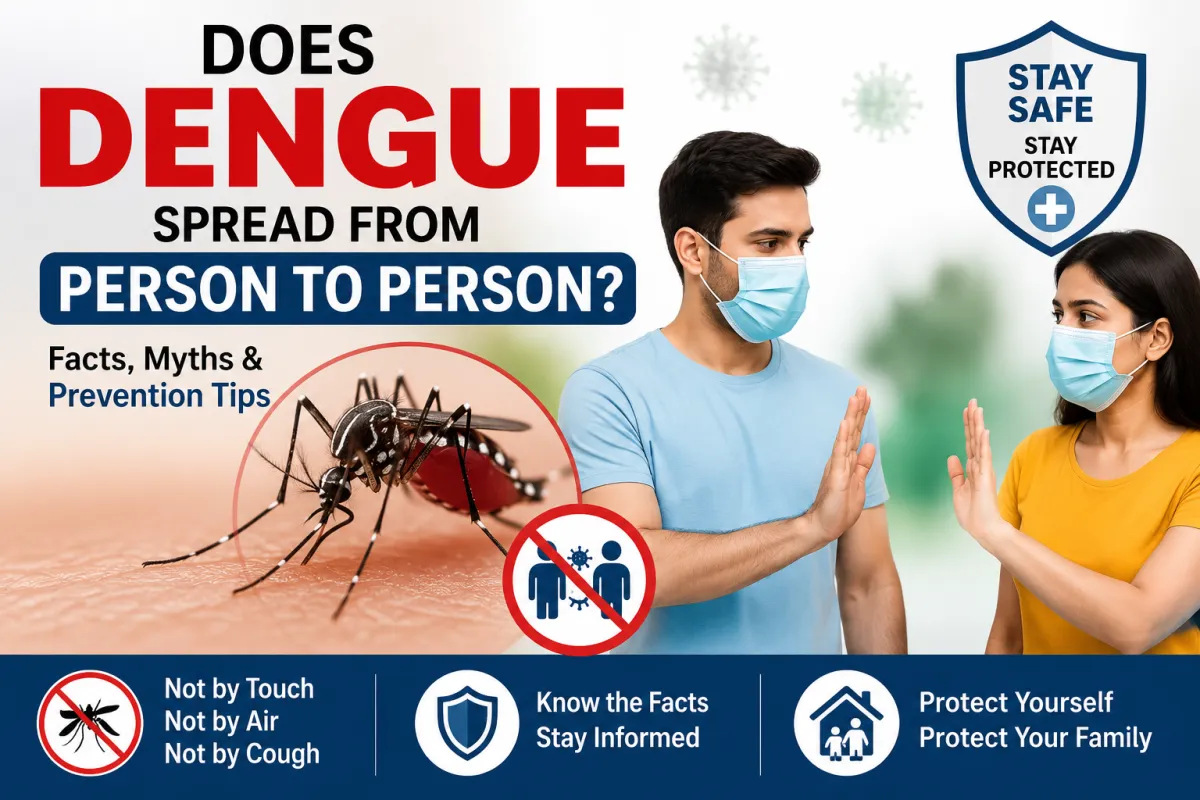
No, dengue does not normally spread directly from person to person through ordinary contact. Dengue mainly spreads when an infected female Aedes mosquito bites someone after picking up the virus from an infected person's blood. Rare exceptions — like transmission through blood transfusion, organ transplant, or from mother to baby — have been documented, but these are uncommon and not the usual way dengue spreads.
If someone in your home or family has dengue, it's completely natural to wonder: does dengue spread from person to person? The short answer is no — you generally can't "catch" dengue the way you'd catch a cold or flu from someone coughing near you. Dengue works differently. It needs a mosquito as the middle step: an infected person's blood carries the virus, a mosquito bites that person and picks up the virus, and only then can that same mosquito pass dengue to someone else it bites later.
This is genuinely reassuring news if you're caring for a family member with dengue — you don't need to isolate them the way you might with a respiratory illness. But it also means the real risk in a household isn't the patient themselves — it's the mosquitoes around them. This article walks through exactly how dengue spreads, the rare exceptions worth knowing about, and practical steps to protect your family.
- Dengue is primarily mosquito-borne — it spreads mainly through infected female Aedes aegypti mosquitoes, not through casual human contact.
- Normal contact — touching, hugging, talking, sharing a room, sitting beside someone — does not spread dengue.
- An infected person can pass the virus to a mosquito that bites them, and that mosquito can then infect other people.
- Rare, documented non-mosquito transmission routes exist: through blood transfusion, organ transplantation, and from mother to baby during pregnancy or delivery.
- Protecting a dengue patient from mosquito bites protects the rest of the household, since it breaks the transmission cycle.
- Multiple family members getting dengue is usually explained by shared exposure to the same mosquito breeding sites nearby, not by person-to-person spread.
- Eliminating standing water and mosquito breeding sites around the home is one of the most effective prevention steps.
1. How Does Dengue Spread?
Dengue spreads through a human → mosquito → human cycle, not directly between people. Here's the simple version:
Dengue patient (virus circulating in blood) → an Aedes mosquito bites the patient and picks up the virus → the virus develops inside the mosquito over several days → the infected mosquito bites another person → that person becomes infected with dengue
The World Health Organization (WHO) explains that dengue is primarily transmitted by the bite of infected female Aedes mosquitoes, mainly Aedes aegypti and, to a lesser extent, Aedes albopictus. The mosquito needs to bite an infected person during the period the virus is circulating in that person's blood (called viremia), and the virus then needs time to develop inside the mosquito before it becomes capable of transmitting the infection to someone else. This is a genuinely important detail — it's not an instant hand-off, and a person cannot pass dengue directly to another person the way, say, a cold spreads through the air.
2. Can Dengue Spread Directly From One Person to Another?
Activities like touching, hugging, shaking hands, sitting beside someone, talking closely, or sharing the same room with a dengue patient do not transmit the virus. This is an important, genuinely reassuring fact for families caring for a dengue patient at home — you don't need to treat dengue like a respiratory infection that requires isolation from the household.
That said, it's worth being precise rather than absolute: while everyday contact isn't a transmission route, a small number of rare, medically documented exceptions exist — through blood products, organ transplantation, and mother-to-child transmission. These are uncommon and covered in detail further below, but they're worth knowing rather than dismissing entirely.
3. Can Dengue Spread Through Touch?
Dengue virus isn't transmitted through skin-to-skin contact. It requires the specific human-mosquito-human cycle described above. You can safely touch, care for, and be physically close to a dengue patient without fear of catching the infection this way.
4. Can Dengue Spread Through Air?
Unlike influenza, COVID-19, or the common cold — which spread through respiratory droplets and aerosols released when an infected person breathes, talks, coughs, or sneezes — dengue virus doesn't travel through the air between people at all. Dengue's only transmission route into a new person is via a mosquito bite. This is one of the clearest ways dengue is fundamentally different from the respiratory illnesses many people naturally compare it to.
5. Can Dengue Spread Through Coughing or Sneezing?
Because dengue is not a respiratory virus, it isn't present in the droplets released when someone coughs or sneezes in a way that would infect another person. You do not need to wear a mask around a dengue patient to prevent this kind of transmission — it isn't a transmission route for this virus.
6. Can Dengue Spread Through Saliva?
Dengue virus is primarily found circulating in the blood during infection, which is what mosquitoes pick up when they bite. There isn't good evidence supporting ordinary saliva contact — like sharing a drink or a spoon — as a way dengue spreads. We'd rather be precise than make a sweeping absolute claim here: the established, medically recognized transmission routes are mosquito bites and the rare exceptions covered later in this article, not saliva exchange through everyday activities.
7. Can Dengue Spread Through Kissing or Hugging?
These are forms of everyday physical contact, and as covered above, dengue simply doesn't transmit through skin contact or through saliva exchanged during a kiss. Affection and physical closeness with a family member who has dengue is safe from a transmission standpoint — the actual risk in your household comes from mosquitoes, not from the patient themselves.
8. Can Dengue Spread Through Sharing Food or Utensils?
Dengue isn't a foodborne or fecal-oral illness like some other infections you might be more familiar with (such as typhoid or hepatitis A). It requires the mosquito-borne transmission cycle, so ordinary food and utensil sharing within a household caring for a dengue patient is not a risk factor for this specific infection.
9. Can Dengue Spread Through Blood?
Yes, rare transmission of dengue through blood has been documented, specifically through:
- Blood transfusion: If a blood donor was infected with dengue (including during the period before they showed symptoms), the virus could theoretically be present in donated blood products.
- Organ transplantation: Similarly, if an organ donor had circulating dengue virus, transmission to the recipient has been documented in rare cases.
WHO and public health authorities recognize these as uncommon, non-primary transmission routes — not the typical way dengue spreads. This is exactly why blood banks and transplant programs follow screening protocols, particularly in dengue-endemic regions and during outbreak periods. This isn't a reason for the general public to worry about routine blood draws or medical procedures — it's a rare, recognized risk that health systems actively screen and account for.
10. Can Dengue Spread From Mother to Baby?
Yes, maternal or "vertical" transmission of dengue from a pregnant woman to her fetus or newborn has been documented, though it's considered uncommon. A few important points:
- The risk appears to be related to the timing of the mother's dengue infection during pregnancy, particularly if infection occurs close to the time of delivery.
- This is a recognized but rare occurrence, not a typical outcome of dengue during pregnancy.
- Pregnant women who develop dengue symptoms need prompt medical supervision, both for their own health and to appropriately monitor the pregnancy and newborn.
If you're pregnant and have been diagnosed with or suspect dengue, this is a situation that calls for close medical guidance from your obstetrician and treating doctor — not something to manage or research independently.
11. Can Dengue Spread Through Sexual Contact?
This is a topic where it's important to be precise about the evidence level. There have been isolated case reports in medical literature suggesting possible sexual transmission of dengue virus, but this evidence is limited, not well-established, and dengue is not considered a sexually transmitted infection in any established medical sense. The overwhelming, well-documented transmission route for dengue remains the mosquito-borne cycle described throughout this article. It would be inaccurate and unnecessarily alarming to present sexual contact as a common or primary way dengue spreads — the evidence simply doesn't support that.
12. Can a Dengue Patient Spread Dengue to Other Family Members?
This distinction matters a lot for how you think about protecting your family:
This is exactly why household mosquito control — not isolating the patient from human contact — is the meaningful protective step. The patient isn't the direct source of risk to others; the mosquitoes that might bite both the patient and other family members are.
13. Why Do Multiple Family Members Get Dengue?
Common shared risk factors include:
- Stagnant or standing water around the home
- Uncovered water storage containers
- Flower pots and their saucers holding water
- Coolers with stagnant water
- Discarded containers, tires, or debris that collect rainwater
- Rooftop water accumulation
- Nearby breeding sites in the neighborhood that a local mosquito population uses
WHO identifies water-filled containers in and around homes as important breeding locations for Aedes mosquitoes. When a household or neighborhood has active mosquito breeding sites, multiple family members are simply exposed to the same infected mosquito population over time — which explains clusters of cases within a family without any direct person-to-person spread being involved.
14. Can a Dengue Patient Infect a Mosquito?
When an Aedes mosquito bites a person who has dengue virus circulating in their blood, the mosquito picks up the virus. According to WHO, people with dengue can be infectious to mosquitoes around the symptomatic period of their illness — this can include a short period before symptoms start and continuing for a few days into the illness, roughly around the time fever is present. The virus then needs time to develop inside the mosquito before that mosquito becomes capable of transmitting it onward to the next person it bites.
15. How Long Can a Dengue Patient Infect Mosquitoes?
This relates to a concept doctors call viremia — the period during which dengue virus is actively circulating in a person's blood at levels high enough for a mosquito to pick it up. Based on WHO guidance, this infectious period for mosquitoes generally spans from shortly before symptom onset through several days into the illness, though the exact duration can vary between individuals. Rather than presenting a single fixed number that applies to everyone, the safest practical approach is simply to protect a dengue patient from mosquito bites throughout their illness, without needing to calculate exactly when the infectious window ends.
16. How to Protect a Dengue Patient From Mosquito Bites
This protects both the patient and the rest of your household, since it breaks the transmission cycle at its source.
- Have the patient sleep under a mosquito net, including during daytime naps (Aedes mosquitoes are known to bite mainly during the day)
- Install or repair window and door screens
- Use mosquito repellents as appropriate for the patient's age and health status
- Dress the patient in full-sleeved, loose clothing where practical
- Use indoor mosquito control measures (such as mosquito coils or vaporizers) as appropriate
- Keep the patient's room well-screened, with air-conditioning where available, since this can reduce mosquito entry
- Eliminate standing water in and around the home
- Cover water storage containers securely
- Prevent mosquito breeding in the immediate surroundings
17. Dengue Prevention at Home
| Prevention Step | Why It Matters |
|---|---|
| Remove standing water | Prevents mosquito breeding at the source |
| Cover water containers | Reduces available breeding sites around the home |
| Use mosquito nets | Reduces bites, especially for patients and children |
| Use repellents | Reduces mosquito exposure for everyone in the household |
| Wear long sleeves | Protects exposed skin, especially during peak mosquito activity hours |
| Use window/door screens | Keeps mosquitoes from entering living spaces |
18. Dengue Transmission vs Other Diseases
| Disease | Main Transmission Route |
|---|---|
| Dengue | Infected Aedes mosquito bite |
| COVID-19 | Respiratory transmission (droplets/aerosols) |
| Influenza | Respiratory transmission (droplets/aerosols) |
| Malaria | Infected Anopheles mosquito bite |
| Chikungunya | Infected Aedes mosquito bite |
This comparison helps explain why dengue behaves so differently from illnesses people often mentally group it with. Diseases like COVID-19 and influenza spread through the air between people, which is why isolation and masking matter for those illnesses. Dengue and chikungunya, by contrast, both rely on the same Aedes mosquito for transmission — which is why mosquito control, not patient isolation, is the meaningful prevention strategy for these diseases.
19. Is Dengue Contagious?
20. What Should You Do If Someone at Home Has Dengue?
- Follow the treating doctor's instructions closely, including any recommended monitoring or testing.
- Prevent mosquito bites for the patient using nets, screens, and repellents.
- Use mosquito protection measures during both daytime and evening, since Aedes mosquitoes are active mainly during the day.
- Remove standing water in and around your home.
- Monitor the patient's symptoms closely, including fever pattern and any new symptoms.
- Maintain hydration as advised by the treating doctor.
- Seek medical attention promptly if any warning signs (see below) develop.
21. Dengue Warning Signs You Should Not Ignore
- Severe abdominal pain
- Persistent vomiting
- Bleeding — including from gums, nose, or under the skin
- Blood in vomit or stool
- Extreme weakness or lethargy
- Restlessness or irritability
- Difficulty breathing
- Signs of shock (cold, clammy skin; rapid weak pulse)
- Reduced urine output
- Symptoms that worsen after fever begins to settle — this specific pattern is an important warning sign, not a sign of recovery
22. When Should You Visit a Doctor?
Mild Symptoms
Fever, headache, mild body aches, and general fatigue without any warning signs — continue medical follow-up as advised, rest, and stay hydrated as directed.
Symptoms Requiring Prompt Medical Evaluation
Persistent high fever, significant weakness, ongoing vomiting, or if you're in a higher-risk group (young children, elderly, pregnant, or with chronic health conditions) — seek evaluation rather than waiting.
Emergency Warning Signs
Any of the warning signs listed in Section 21 — these require immediate medical attention, ideally at a hospital equipped to manage dengue complications.
23. Common Dengue Myths vs Facts
Fact: Touching, hugging, or normal physical contact with a dengue patient does not transmit the virus.
Fact: Dengue is not airborne or a respiratory infection; it requires a mosquito bite to transmit between people.
Fact: Sharing food, utensils, or drinks with a dengue patient does not spread the virus.
Fact: Isolation from human contact isn't necessary for dengue — the real priority is protecting the patient (and household) from mosquito bites.
Fact: A dengue patient can infect mosquitoes that bite them during the period the virus is circulating in their blood — this is the key step in how dengue actually spreads onward.
Fact: This isn't automatic — it depends on whether other family members are exposed to infected mosquitoes, not on contact with the patient themselves.
Fact: Only certain mosquito species — mainly Aedes aegypti and, to a lesser extent, Aedes albopictus — are known to transmit dengue, not all mosquito species.
Fact: Aedes mosquitoes, the main dengue vector, are actually most active during the day, particularly early morning and late afternoon — unlike malaria-spreading Anopheles mosquitoes, which are more active at night.
Fact: Since there are four distinct dengue virus serotypes, a person can be infected more than once with different serotypes, and in some cases a second infection can be more severe.
Fact: Infection typically provides long-term immunity to that specific serotype, but not necessarily to the other three dengue serotypes.
Fact: A rash can occur in some dengue cases, but it's not present in everyone, so its absence doesn't rule out dengue.
Fact: Symptoms alone aren't enough for a reliable diagnosis — laboratory testing (such as NS1 antigen or antibody tests) is typically needed to confirm dengue.
Fact: The period after fever starts to settle is actually a critical window where warning signs of severe dengue can appear, so close monitoring should continue.
Fact: There is no established medical cure for dengue; treatment is supportive care under medical guidance, and unproven remedies shouldn't replace medical monitoring.
Fact: Dengue can affect people of any age; while children are a notable risk group, adults are affected too, sometimes with more severe symptoms.
24. डेंगू के लक्षण होने पर डॉक्टर से कब मिलें?
अगर आपके परिवार में किसी को तेज़ बुखार, शरीर में दर्द, या डेंगू के अन्य लक्षण महसूस हो रहे हैं, तो इसे नज़रअंदाज़ न करें — खासकर अगर बुखार उतरने के बाद भी कमजोरी, पेट दर्द या उल्टी जैसी समस्याएं बनी रहें। सही समय पर जांच और डॉक्टर की सलाह से जटिलताओं से बचा जा सकता है।