Ebola Outbreak Symptoms: Early Signs, Causes, Treatment and Prevention
Updated on: September 28, 2026 | Medically reviewed by: Dr. Vikrant Solanki
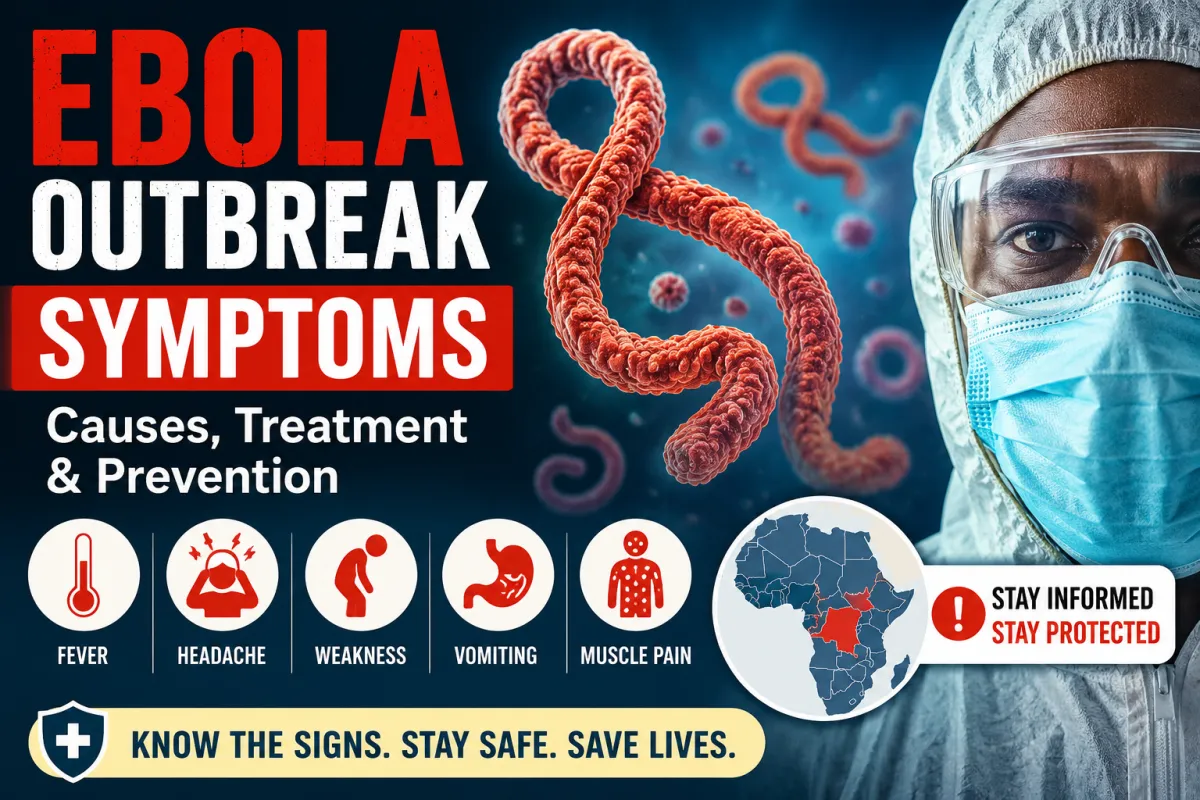
Ebola outbreak symptoms explained: early warning signs, causes, transmission, treatment and prevention, with the latest verified 2026 outbreak update.
Early Ebola symptoms can include sudden fever, severe headache, weakness, muscle pain, and sore throat, typically appearing within a few days to about three weeks after exposure. As illness progresses, later symptoms can include vomiting, diarrhea, abdominal pain, and, in some patients, unexplained bleeding or bruising. These symptoms overlap with many other common infections, so symptoms alone cannot confirm Ebola — laboratory testing is required.
If you're searching for "ebola outbreak symptoms," you've likely heard about the Ebola outbreak currently affecting the Democratic Republic of the Congo (DRC) and, until recently, Uganda. Ebola virus disease is a serious viral illness, and understanding its early warning signs matters — but it's important to know upfront that fever alone does not mean Ebola, especially outside the specific outbreak-affected regions. This article explains what Ebola is, its current outbreak status as of August 2026, its symptoms and how they progress, how it spreads, and what prevention and treatment actually involve — based on verified information from WHO, CDC, and other recognized health authorities, not speculation.
- Ebola virus disease (EVD) is a severe viral illness; the current 2026 outbreak in the DRC and Uganda is caused specifically by the Bundibugyo virus (BDBV), one of several Ebola virus species.
- Early symptoms include fever, severe headache, weakness, muscle pain, and sore throat; later symptoms can include vomiting, diarrhea, abdominal pain, and in some cases unexplained bleeding.
- Ebola spreads through direct contact with the blood or body fluids of an infected person, not through casual contact, food, water, or routine respiratory transmission — it is not airborne.
- The incubation period is typically 2 to 21 days after exposure, meaning symptoms don't appear immediately.
- Unlike the Zaire ebolavirus species, there is currently no licensed vaccine or specific approved therapeutic for Bundibugyo virus — treatment relies on early, aggressive supportive care, though clinical trials of potential therapies are underway.
- Diagnosis requires laboratory testing and cannot be made from symptoms alone; exposure history is critical to clinical assessment.
- Those at highest risk are household caregivers, healthcare workers, and people involved in burial practices for people who died of Ebola in affected areas — not the general public in unaffected regions.
- As of August 10, 2026, the DRC has reported 4,381 confirmed cases and 2,011 deaths in this outbreak; Uganda's outbreak was declared over on July 28, 2026.
1. What Is Ebola?
Ebola virus disease (EVD), sometimes historically called Ebola hemorrhagic fever, is a severe and often fatal viral illness caused by viruses in the Ebolavirus genus. In simple terms: it's a rare but serious infection that can cause high fever and, in more severe cases, affect multiple organ systems and cause bleeding problems in some patients.
There are several distinct species of Ebola virus, including Zaire ebolavirus (historically the most studied and the species for which approved vaccines and treatments exist), Sudan ebolavirus, and Bundibugyo virus (BDBV) — the species responsible for the current 2026 outbreak. This distinction matters medically, because approved vaccines and treatments developed for one species do not automatically work the same way against another.
Ebola outbreaks have historically occurred primarily in parts of Central and East Africa, including the Democratic Republic of the Congo, which has now experienced 17 recorded Ebola outbreaks, including the current one. Ebola can be serious because, without prompt supportive care, it can progress to severe illness affecting hydration status, blood pressure, and organ function — which is why early recognition and medical care meaningfully improve outcomes.
2. Ebola Outbreak 2026 — What Is Happening?
| Information | Latest Verified Details |
|---|---|
| Country/Region | Democratic Republic of the Congo (DRC) — primarily Ituri, North Kivu, South Kivu, Haut-Uélé, and Tshopo provinces; Uganda (outbreak now declared over) |
| Virus species | Bundibugyo virus (BDBV), a species of Ebola virus |
| Outbreak declared | May 15, 2026 by DRC's Ministry of Public Health (the 17th Ebola outbreak in DRC's history); WHO declared it a Public Health Emergency of International Concern (PHEIC) on May 16–17, 2026 |
| Confirmed cases | 4,381 (DRC, as of data through August 9, 2026) |
| Deaths | 2,011 (DRC, as of data through August 9, 2026) — a crude case fatality ratio around 44–46% |
| Hospitalized in isolation | 704 patients (as of the August 10, 2026 DRC situation update) |
| Uganda status | Outbreak declared over on July 28, 2026, after the last patient was discharged on July 16 and no new cases emerged for the required monitoring period |
| International cases | Imported cases reported in Germany (via medical evacuation) and France (June 24, 2026); both linked to exposure in DRC. No cases confirmed in the United States as of the CDC's August 7, 2026 update |
| Health authorities involved | WHO, DRC Ministry of Public Health, Uganda Ministry of Health, US CDC, ECDC, Africa CDC, MSF/Doctors Without Borders |
| Date of latest update used in this article | Figures current as of WHO/DRC data through August 9–10, 2026 |
According to WHO's Disease Outbreak News, the outbreak began in Mongbwalu Health Zone, Ituri Province, with the earliest infections now believed to date back to January or February 2026, possibly linked to a funeral. Laboratory testing confirmed the cause as Bundibugyo virus disease on May 15, 2026. Since then, the outbreak has expanded from a single health zone to affecting 49 health zones across five provinces of the DRC.
Health authorities, including WHO and MSF, are conducting surveillance, contact tracing, clinical care, and community engagement work in affected areas. As of the CDC's August 7, 2026 update, no Ebola cases linked to this outbreak have been confirmed in the United States, and the overall risk to the American public and most international travelers outside directly affected areas is considered low. The European Centre for Disease Prevention and Control (ECDC) similarly assesses the likelihood of infection for people living in the EU/EEA as very low, though isolated imported cases (Germany, France) have occurred among people with direct exposure history in DRC.
There is currently no confirmed evidence of sustained wider community transmission outside the affected DRC provinces and the now-resolved Uganda outbreak.
3. Ebola Outbreak Symptoms — What Are the Early Signs?
| Symptom | What It May Feel Like | Typical Stage |
|---|---|---|
| Sudden fever | Rapid onset of high body temperature | Early |
| Severe headache | Intense, often described as more severe than a typical headache | Early |
| Weakness/fatigue | Pronounced tiredness, difficulty with normal activity | Early |
| Muscle pain | Generalized body aches | Early |
| Sore throat | Throat discomfort, sometimes with difficulty swallowing | Early |
Because these early symptoms overlap so heavily with common illnesses like influenza, malaria, and typhoid, exposure history — such as travel to or residence in an affected area, or contact with a person diagnosed with Ebola — is critical context for any clinical evaluation. Outside outbreak-affected regions, fever with these symptoms is far more likely to have a different, more common cause, but exposure history is what changes the clinical picture.
4. Later Symptoms of Ebola
As Ebola illness progresses without treatment, additional symptoms can develop, though not every patient experiences every symptom:
- Vomiting
- Diarrhea
- Abdominal pain
- Rash
- Impaired kidney and liver function
- Unexplained bleeding or bruising in some patients (for example, from the gums, nose, or under the skin)
- Severe illness or shock in serious, advanced cases
It's worth being clear here: not every Ebola patient develops the bleeding symptoms that the illness is popularly associated with — this is one of the most common misconceptions about the disease, addressed further in the myths section below.
5. Ebola Symptoms Timeline
| Phase | What Happens |
|---|---|
| Exposure | Contact with blood/body fluids of an infected person or, in some cases, an infected animal in an outbreak-affected area |
| Incubation period | Typically 2 to 21 days; the person does not yet show symptoms |
| Early symptoms | Sudden fever, headache, weakness, muscle pain, sore throat — usually appearing abruptly |
| Progression (without treatment) | Vomiting, diarrhea, abdominal pain, and in some patients, bleeding or bruising; organ function can become affected |
| Outcome | Recovery with supportive care in many cases, though outcomes vary based on timing of care, virus species, and individual factors; severe complications can occur in advanced or untreated cases |
This timeline reflects the general pattern described by CDC and WHO and does not represent an exact schedule for every patient — individual progression varies.
6. Ebola Incubation Period
This means a person exposed to Ebola may not show any symptoms for up to three weeks. This is exactly why public-health authorities use monitoring periods of up to 21 days for people with known exposure. Importantly, a person without symptoms during this incubation window is not considered infectious under the standard understanding of Ebola transmission — infectiousness is generally linked to the presence of symptoms and viral load in body fluids, not simply to having been exposed.
7. What Causes Ebola?
Scientific evidence points to certain wildlife species as likely natural reservoirs involved in initial spillover events, though the precise original source of a given outbreak isn't always definitively confirmed — this is an area of ongoing scientific investigation rather than a fully settled fact for every outbreak. Once the virus enters the human population, it spreads through human-to-human transmission via direct contact with infected body fluids, not through further animal contact for most cases in an established outbreak.
In the case of the current 2026 outbreak, WHO investigation has suggested the earliest human infections likely occurred around January–February 2026 in the Mongbwalu area of Ituri Province, DRC, possibly linked to a funeral gathering — though the full picture of the outbreak's origins continues to be investigated.
8. How Does Ebola Spread?
Ebola spreads through:
- Direct contact with blood or body fluids of a person who is sick with or has died from Ebola (including blood, vomit, urine, feces, sweat, saliva, breast milk, and semen)
- Contact with contaminated objects, such as needles, syringes, or medical equipment
- Caregiving without appropriate protection, since close, prolonged contact with a sick person increases exposure risk
- Healthcare exposure in settings without proper infection-control procedures
- Unsafe burial practices involving direct contact with the body of someone who died from Ebola, since viral load can remain high in the body after death
- Sexual transmission, since the virus can persist in certain body fluids (such as semen) in male survivors for a period after recovery — this is why survivors receive guidance on safe practices during follow-up care, based on scientific evidence from previous outbreaks
9. Can Ebola Spread From Person to Person?
10. Is Ebola Airborne?
It's worth being precise about the distinction between transmission types:
- Airborne transmission (like measles) involves a virus remaining suspended and infectious in the air over distance and time.
- Respiratory droplet transmission (like influenza and COVID-19) involves larger droplets from coughing or talking that typically travel shorter distances.
- Direct contact/body-fluid transmission (Ebola's actual transmission route) requires physical contact with infected blood or body fluids, not simply being near an infected person or breathing shared air.
Ebola falls into the last category. This is a meaningful distinction, since it explains why Ebola outbreaks, even severe ones, can be contained through targeted infection-control measures rather than the broader respiratory-precaution measures used for airborne or droplet-spread diseases.
11. Is Ebola Contagious?
Under the standard understanding of Ebola transmission, people are not considered infectious before symptoms begin. Infectiousness — and the associated risk to others — generally increases as illness progresses and viral load in body fluids rises, which is part of why early isolation and care of symptomatic patients is such a central part of outbreak response.
12. Who Is at Higher Risk of Ebola Exposure?
- Household caregivers of a person sick with Ebola
- Healthcare workers, particularly those without adequate personal protective equipment or infection-control training
- People directly caring for infected patients in any setting
- People involved in unsafe burial practices for someone who died from Ebola
- Laboratory personnel handling potentially infected samples
- People with direct exposure to the body fluids of an infected person or, during initial spillover events, certain wildlife
It's important to note clearly: ordinary members of the public — including those outside the DRC and Uganda, and even most people within those countries who have no direct exposure to a sick patient or their body fluids — are not automatically at high risk from this outbreak.
13. Ebola Diagnosis
- Symptoms alone cannot confirm Ebola, since they overlap with many other infections
- Exposure history — travel to or residence in an affected area, contact with a confirmed case — is a critical part of clinical assessment
- Laboratory testing (such as specialized viral testing) is required for confirmation
- Healthcare workers use specialized infection-control procedures when evaluating suspected cases, to protect themselves and others
- Suspected cases require urgent public-health assessment and reporting to relevant health authorities
14. Ebola Treatment
- Supportive care: The foundation of Ebola treatment, including careful fluid and electrolyte management
- Hydration: Often critical, since vomiting and diarrhea can cause significant fluid loss
- Oxygen/respiratory support: Provided when needed based on clinical status
- Blood pressure management: An important part of supportive care in more severe cases
- Treatment of secondary infections or complications: Addressed as they arise, under medical supervision
- Specialized therapeutics: Certain monoclonal antibody treatments have regulatory approval specifically for Zaire ebolavirus — they are not automatically approved or proven effective against other species
This article does not provide specific prescription dosing information, as treatment decisions must be made by qualified treating physicians based on individual clinical assessment.
15. Can Ebola Be Cured?
It would be inaccurate to say Ebola simply "has no cure" — for Zaire ebolavirus specifically, approved monoclonal antibody treatments exist and have improved survival when given early. However, for the Bundibugyo virus responsible for the current outbreak, no specific approved therapeutic currently exists, and outcomes depend heavily on early, high-quality supportive care. The crude case fatality ratio reported for this outbreak (around 44–46%) reflects the seriousness of the illness in this real-world context, though case fatality rates for Bundibugyo virus disease in past outbreaks have historically ranged from roughly 30–50%, and outcomes can improve significantly with rapid, well-resourced supportive care.
16. Ebola Vaccine
- Existing licensed Ebola vaccines target Zaire ebolavirus specifically and have been used in "ring vaccination" strategies during past Zaire ebolavirus outbreaks
- These vaccines do not automatically protect against other Ebola virus species, including Bundibugyo virus
- For the current outbreak, WHO has convened technical advisory groups, including the Strategic Advisory Group of Experts on Immunization (SAGE), to assess candidate vaccines and therapeutics specifically for Bundibugyo virus disease
- Vaccine availability and recommendations depend on the country, the specific outbreak, and evolving public-health guidance — this is not a one-size-fits-all situation
17. Ebola Prevention
- Avoid direct contact with the blood or body fluids of people who are sick with or have died from Ebola
- Healthcare workers and caregivers should use appropriate personal protective equipment (PPE)
- Practice regular hand hygiene
- Follow infection-control procedures in healthcare and caregiving settings
- Support and follow safe burial practices in affected areas
- Avoid contact with body fluids of potentially infected animals in outbreak-affected regions
- Follow guidance from local public-health authorities in and around affected areas
- Consider vaccination where recommended by health authorities based on virus species and exposure risk
18. Ebola Prevention in Hospitals and Healthcare Settings
- Personal protective equipment (PPE): Full protective gear for healthcare workers caring for suspected or confirmed patients
- Isolation: Suspected and confirmed patients are cared for in isolation facilities designed to prevent transmission
- Infection prevention and control protocols: Strict procedures for all patient contact
- Safe waste management: Careful handling and disposal of medical waste
- Environmental cleaning: Thorough disinfection protocols in care areas
- Trained healthcare teams: Staff specifically trained in Ebola infection control, as seen in MSF's dedicated Ebola treatment centers in the current outbreak response
- Safe specimen handling: Laboratory samples require specialized handling procedures
19. Ebola vs Common Flu vs COVID-19
| Feature | Ebola | Influenza | COVID-19 |
|---|---|---|---|
| Virus | Ebolavirus species (e.g., Bundibugyo virus, Zaire ebolavirus) | Influenza virus | SARS-CoV-2 |
| Main transmission | Direct contact with infected blood/body fluids | Respiratory droplets/aerosols | Respiratory droplets/aerosols |
| Fever | Common, often sudden onset | Common | Common, variable |
| Headache | Common, often severe | Common | Common |
| Body aches | Common | Common | Common |
| Cough | Not a typical primary symptom | Common | Common |
| Vomiting/diarrhea | Common as illness progresses | Uncommon | Sometimes present |
| Bleeding | Possible in some patients in later stages | Not typical | Not typical |
| Typical public-health concern | High case fatality in outbreak settings; requires strict infection control | Seasonal burden; generally lower fatality | Widespread transmissibility; variable severity |
Symptoms overlap significantly between these illnesses, and diagnosis cannot be made from symptoms alone — exposure history and testing are essential, particularly for Ebola given the serious implications of a suspected case.
20. Ebola vs Malaria vs Dengue
| Feature | Ebola | Malaria | Dengue |
|---|---|---|---|
| Cause | Ebolavirus species | Plasmodium parasite | Dengue virus |
| Transmission | Direct contact with infected blood/body fluids | Infected Anopheles mosquito bite | Infected Aedes mosquito bite |
| Fever pattern | Sudden onset, often high | Can be cyclical/recurring | Sudden, often high |
| Bleeding risk | Possible in some patients, later stages | Uncommon, except in severe cases | Possible in severe dengue |
| Geographic overlap | Parts of Africa, including current DRC/Uganda outbreak areas | Widespread in tropical/subtropical regions including parts of Africa and India | Widespread in tropical/subtropical regions including India |
Because fever is common to many infectious diseases, people should not self-diagnose based on fever alone — whether the concern is Ebola, malaria, dengue, or another cause entirely. Medical evaluation and appropriate testing are the only reliable way to know.
21. When Should You Seek Medical Help?
Seek urgent medical evaluation if:
- You have had a possible Ebola exposure (contact with a confirmed case, their body fluids, or travel to/residence in an actively affected area)
- Fever develops after a relevant exposure
- Significant symptoms occur following travel to or residence in an outbreak area
- Severe illness of any kind develops
22. What Should You Do If You Think You Were Exposed to Ebola?
- Avoid unnecessary close contact with others.
- Contact a healthcare or public-health authority promptly.
- Clearly explain your exposure history when you contact them.
- Follow their instructions regarding evaluation, monitoring, and transport.
- Do not handle potentially contaminated blood or body fluids yourself.
- Do not attempt to diagnose yourself or others at home.
23. Ebola Myths vs Facts
Fact: Ebola spreads through direct contact with infected blood or body fluids, not through casual touch like handshakes with someone who isn't symptomatic and hasn't had relevant exposure.
Fact: Ebola is not airborne; it requires direct contact with infectious body fluids to spread between people.
Fact: Fever has many common causes; Ebola should only be suspected alongside a relevant exposure history, and confirmed only through laboratory testing.
Fact: Supportive care meaningfully improves outcomes, and specific approved therapeutics exist for some Ebola virus species (though not currently for Bundibugyo virus, the species in this outbreak).
Fact: Not every Ebola patient develops bleeding symptoms; this is a common misconception drawn from the disease's historical name, "Ebola hemorrhagic fever."
Fact: Ebola isn't a typical foodborne illness in the way something like typhoid is; it requires direct contact with infected body fluids, though contact with infected wild animal meat during initial spillover events is a recognized risk factor in specific contexts.
Fact: Ebola is not a mosquito-borne disease, unlike malaria or dengue; it spreads through direct contact with infected blood or body fluids.
Fact: Ebola outbreaks have historically been concentrated in parts of Africa, but isolated imported cases have occurred elsewhere (as with the current outbreak's cases in Germany and France) through travel from affected areas.
Fact: Symptoms typically appear after an incubation period of 2 to 21 days, not immediately.
Fact: Licensed vaccines currently target Zaire ebolavirus specifically; they don't automatically protect against other species like Bundibugyo virus.
Fact: Many patients survive with timely, appropriate supportive care; case fatality rates vary by virus species, outbreak context, and access to care.
Fact: The virus can persist in certain body fluids (such as semen) in some male survivors for a period after recovery, which is why survivors receive specific follow-up guidance.
Fact: Diagnosis requires laboratory testing combined with exposure history; symptoms alone are not sufficient given their overlap with other illnesses.
Fact: Ebola is caused by a virus, not bacteria, so antibiotics don't treat the infection itself, though they may be used to treat a separate bacterial complication if one develops.
Fact: There is no evidence that herbal or home remedies cure Ebola; supportive medical care and, where available, approved therapeutics are the evidence-based approach.
24. Ebola Outbreak — What Travelers Should Know
- Follow current official travel advisories from your government and health authorities before traveling to or from affected areas
- Check official WHO, CDC, or relevant national health authority updates for the latest outbreak status
- Avoid unnecessary contact with sick individuals or their body fluids in affected areas
- Follow any vaccination requirements or recommendations that apply to your specific situation and destination
- Seek medical advice promptly after any relevant exposure, especially if symptoms develop within 21 days of potential exposure
As of the CDC's August 2026 update, the overall risk to travelers not directly visiting or working in actively affected areas of the DRC remains low, and no cases linked to this outbreak have been confirmed in the United States. That said, anyone with a genuine travel history to affected areas should stay alert to symptoms for the full incubation period and know how to contact health authorities if needed.
25. Ebola Symptoms Ya Exposure Ka Sandeh Ho Toh Doctor Se Kab Sampark Karein?
Agar aapko lagta hai ki aapko Ebola-affected area mein exposure hua hai, ya aapme is article mein bataye gaye lakshan exposure history ke saath dikh rahe hain, to isse halke mein na lein. Sabse pehla kadam hai turant local health authority ya doctor se sampark karna aur unki instructions follow karna.
Note: As of this update, this outbreak remains concentrated in specific provinces of the DRC, with the Uganda outbreak declared over. There is no indication of active Ebola transmission in India at this time. This section is provided for general awareness and for anyone with a genuine relevant travel or exposure history.