QDENGA Vaccine: Benefits, Eligibility, Side Effects, Cost & Everything You Need to Know
Updated on: October 26, 2026 | Medically reviewed by: Dr. Vikrant Solanki
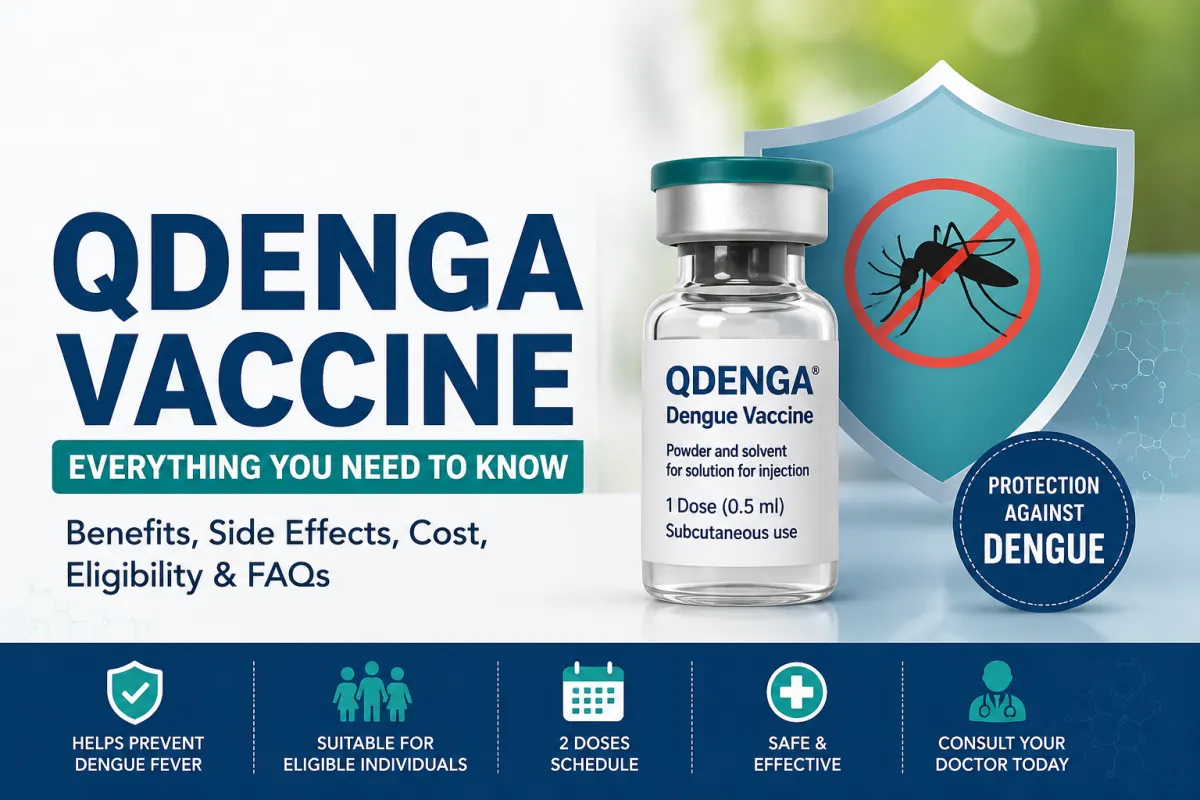
Dengue has become one of India's fastest-growing public health concerns, with reported cases rising sharply over the past two decades, especially during and after the monsoon. For years, prevention meant one thing only: avoiding mosquito bites. That has now started to change with the arrival of the QDENGA vaccine, the first dengue vaccine ever approved for use in India.
This guide covers everything you need to know about the QDENGA vaccine — what it is, how it works, who should and shouldn't take it, its side effects, how well it works, its approval and availability status in India, and what it will likely cost. We've based this on official regulatory announcements, WHO guidance, and peer-reviewed clinical data, clearly separating what is established fact from what is still evolving.
What Is Dengue?
| Aspect | Details |
|---|---|
| Cause | Dengue virus (DENV-1, DENV-2, DENV-3, DENV-4), a flavivirus with four distinct serotypes |
| Transmission | Bite of an infected Aedes aegypti (and sometimes Aedes albopictus) mosquito; not spread person-to-person |
| Common symptoms | High fever, severe headache, pain behind the eyes, joint/muscle pain, nausea, rash |
| Severe dengue warning signs | Persistent vomiting, severe abdominal pain, bleeding, breathing difficulty, lethargy |
| Risk factors | Living in or travelling to endemic urban/semi-urban areas, monsoon season, stagnant water near homes, prior dengue infection (raises risk of severe disease on reinfection) |
India has seen a sharp rise in reported dengue cases over the past two decades and currently accounts for a substantial share of the global dengue burden, with tens of thousands of cases reported annually. Because there is still no specific antiviral cure for dengue, prevention — through both mosquito control and, now, vaccination — is central to reducing its impact.
What Is the QDENGA Vaccine?
- Manufacturer: Developed by Takeda (Takeda GmbH); in India it is imported and distributed by Takeda Biopharmaceuticals India Pvt. Ltd., with local manufacturing support from Biological E. Limited under a 2024 partnership, planned for up to 50 million doses a year.
- Vaccine type: Live-attenuated (weakened live virus) tetravalent vaccine, built using recombinant DNA technology on a dengue serotype-2 backbone.
- Scientific background: QDENGA is supported by a large global clinical trial programme (including the pivotal TIDES/DEN-301 study) spanning endemic and non-endemic countries, with follow-up data extending several years.
- Global regulatory approvals: First approved by the European Medicines Agency in December 2022, followed by approvals in more than 40 countries across Asia, Latin America, and Europe, including Indonesia, Brazil, Argentina, Thailand, and the UK.
- WHO recommendation: WHO's Strategic Advisory Group of Experts (SAGE) recommended in September 2023 that QDENGA be introduced for children aged 6–16 in areas with high dengue transmission intensity. The vaccine received WHO prequalification in May 2024.
- India approval status: QDENGA received market authorisation from India's Drug Controller General (DCGI) on 20 July 2026, becoming India's first approved dengue vaccine, indicated for individuals aged 4 to 60 years.
How Does the Vaccine Work?
QDENGA works like many other vaccines: it introduces a weakened version of the virus that cannot cause dengue disease but is similar enough to train your immune system. Your body builds antibodies against all four dengue serotypes, so if you're later exposed to the real virus, your immune system can recognise and fight it off faster — reducing your chances of getting sick, and especially reducing your chances of severe dengue.
Because it contains a live, weakened virus, a small amount of vaccine virus can briefly circulate in the blood in some people during the first couple of weeks after the first dose — this is expected, usually harmless, and is one reason dengue tests should not be relied upon shortly after vaccination.
Who Should Take the QDENGA Vaccine?
- Children and adults aged 4–60 years, per India's current approval
- Residents of dengue-endemic or high-transmission regions, including much of urban and semi-urban India
- People with a history of previous dengue infection, who tend to show strong, broad protection after vaccination
- Frequent travellers to dengue-endemic countries or regions (individual risk-benefit discussion recommended)
- Families wanting an additional layer of protection alongside mosquito control measures
WHO's specific recommendation highlights children aged 6–16 in high-transmission settings as a priority group, since this is where the vaccine's population-level impact has been most clearly demonstrated in clinical trials.
Who Should NOT Take the QDENGA Vaccine?
| Group | Why |
|---|---|
| Pregnant women | Contraindicated, as QDENGA is a live-attenuated vaccine; safety in pregnancy has not been established |
| Breastfeeding women | Contraindicated; it is unknown whether the vaccine virus passes into breast milk |
| People significantly immunocompromised | Generally not recommended, as is standard practice for all live-attenuated vaccines (e.g., certain cancer treatments, organ transplant medication, advanced HIV) — discuss your specific situation with your doctor |
| History of severe allergic reaction to a previous dose or vaccine component | Contraindicated due to risk of anaphylaxis |
| People with acute severe febrile illness | Vaccination should be postponed until recovery; a mild cold is not a reason to delay |
| Adults over 60 | Outside India's currently approved age range; safety and efficacy data in this age group are limited |
Women of childbearing potential are generally advised to avoid becoming pregnant for at least one month after each dose. Always share your complete medical history, allergies, and current medications with your doctor before vaccination.
Dosage Schedule
| Detail | Information |
|---|---|
| Number of doses | 2 |
| Interval between doses | 3 months (Day 0 and Month 3) |
| Route | Subcutaneous injection (0.5 ml) |
| Pre-vaccination testing | Not required |
| Missed second dose | Contact your doctor to reschedule as soon as possible; there is no single universal catch-up rule, so individual medical guidance is needed |
Benefits of the QDENGA Vaccine
- Reduced risk of symptomatic dengue: Clinical trials showed substantial protection against virologically confirmed dengue.
- Strongly reduced hospitalization risk: Trial data showed an even higher protective effect against dengue-related hospitalization than against mild infection alone.
- Protection across all four serotypes: Especially strong and consistent in people with prior dengue exposure.
- Durable protection: Follow-up studies show continued protection extending several years after vaccination.
- No pre-screening hurdle: Can be offered broadly without needing a prior blood test, simplifying vaccination programmes.
- Complements — not replaces — mosquito control: Adds a second, independent layer of protection alongside bite-prevention measures.
Possible Side Effects
| Category | Examples | Approx. Frequency (Trials) |
|---|---|---|
| Very common | Injection site pain, headache, myalgia (muscle pain), injection site redness, malaise, tiredness | Injection site pain ~50%; headache ~35%; myalgia ~31%; redness ~27%; malaise ~24%; tiredness ~20% |
| Common | Fever, decreased appetite (more common in children), mild swelling or bruising at injection site | Fever ~11% |
| Less common | Dizziness, swollen lymph nodes, rash | Uncommon to rare |
| Rare/serious | Severe allergic reaction (anaphylaxis) | Very rare, as with any vaccine |
When to seek medical attention: Contact a doctor promptly if you experience difficulty breathing, facial or throat swelling, a widespread rash with dizziness or fainting, or a fever that is very high or doesn't improve after a few days. Most vaccination centres observe patients for a short period after the injection specifically to watch for immediate allergic reactions.
Vaccine Effectiveness
| Measure | Result (Clinical Trial Data) |
|---|---|
| Efficacy vs. symptomatic dengue (1 year post 2nd dose) | ~80% |
| Efficacy vs. dengue hospitalization (18 months) | ~90% |
| Efficacy vs. hospitalization (4.5-year follow-up) | ~84% |
| Long-term follow-up | Continued protection against dengue disease and hospitalization observed through 7 years in extended follow-up across all four serotypes |
No vaccine is 100% effective, and QDENGA does not replace basic dengue prevention measures like mosquito control. Real-world effectiveness is still being monitored as the vaccine is used more widely across different countries and populations.
Is the QDENGA Vaccine Available in India?
This is an important distinction: approval means Indian regulators have reviewed the vaccine's safety, quality, and efficacy data and authorised its use in the country. Commercial availability means the vaccine is actually being manufactured, distributed, and administered at hospitals and clinics. As of this article's publication, QDENGA has cleared the first step but not yet the second.
- Regulatory body: Central Drugs Standard Control Organisation (CDSCO), under India's Ministry of Health & Family Welfare
- Approval date: 20 July 2026
- Approved age group: 4 to 60 years
- Local manufacturing: Biological E. Limited (Hyderabad) is partnering with Takeda to manufacture doses in India
- Expected commercial launch: First half of 2027, according to Takeda
Nova Hospital is closely following this rollout and will update patients as soon as the vaccine becomes available for administration. If you're interested in being informed when vaccination opens up, get in touch with our team or ask during your next consultation with our Internal Medicine or Pediatrics department.
QDENGA Vaccine Price in India
What is the expected QDENGA vaccine price?
| Source | Reported QDENGA Vaccine Price | Status |
|---|---|---|
| Health policy commentary (reported by The Hindu; cited via Vision IAS and Drishti IAS, April 2026) | ₹3,000–6,000 per dose; ₹6,000–12,000 for the full two-dose course | Pre-launch analyst estimate, not an official price |
| Hospital physician commentary (CK Birla Hospital, reported July 2026) | Likely to be below ₹10,000 | Doctor's expectation, not an official price |
| Takeda / CDSCO official QDENGA vaccine price | Not yet announced | Expected to be confirmed closer to the H1 2027 India launch |
So while there is no confirmed, official QDENGA vaccine price yet, most current estimates point to a full two-dose course likely costing somewhere in the ₹6,000–₹12,000 range in the private market once launched — broadly "under ₹10,000" by some doctors' estimates. Treat these figures as informed projections rather than the final QDENGA vaccine price, since the actual amount will depend on several factors:
- Whether the vaccine is procured through private hospitals/pharmacies or a public health/government programme
- Local manufacturing costs (via the Biological E. partnership) versus imported stock
- Two doses are required, so the total QDENGA vaccine price should be calculated for the full course, not per dose
- Hospital consultation charges are typically separate from the vaccine price itself and vary by facility
Nova Hospital will publish the confirmed QDENGA vaccine price as soon as it is officially available, and will always clearly label any figure shared before then as an estimate rather than a final price.
Dengue Prevention Tips
- Eliminate standing water: Empty coolers, flower pots, tyres, and containers weekly — this is where Aedes mosquitoes breed
- Use repellents: Apply DEET or picaridin-based repellent on exposed skin, especially during early morning and late afternoon
- Wear protective clothing: Long sleeves and full-length trousers reduce exposed skin, particularly during outbreaks
- Use mosquito nets and screens: Especially for infants, elderly family members, and during sleep or rest
- Community cleanliness: Support local efforts to clear breeding sites in your neighbourhood
- Early diagnosis: Get tested promptly for high fever during dengue season rather than waiting it out
- Stay hydrated: Fluid intake is important if you do develop dengue symptoms, alongside medical monitoring
When Should You Visit a Hospital?
- Persistent high fever lasting more than 2–3 days without improvement
- Severe or persistent abdominal pain
- Persistent vomiting
- Any signs of bleeding (gums, nose, blood in vomit or stool, unusual bruising)
- Difficulty breathing
- Signs of dehydration (reduced urination, dizziness, extreme thirst)
- Confusion, restlessness, or lethargy
- Cold, clammy skin or a rapid, weak pulse (signs of low blood pressure)
These can be signs of severe dengue, which requires prompt hospital-based monitoring and care. Don't wait for all symptoms to appear — early evaluation saves lives.
Conclusion
QDENGA's approval in India marks a genuine turning point in the fight against dengue — the country's first dedicated vaccine against a disease that affects hundreds of thousands of people every year. It is not a magic bullet: protection varies by prior exposure and serotype, two doses are needed, and it works best alongside — not instead of — mosquito control. Commercial availability is still around the corner, expected in the first half of 2027, and pricing has not yet been announced.
Until then, the fundamentals remain your best defence: eliminate mosquito breeding sites, protect your skin, and seek medical care early if fever develops. Nova Hospital is committed to keeping patients informed as QDENGA becomes available, and our team is ready to guide you on dengue prevention, diagnosis, and treatment today. Consult Nova Hospital for personalised advice on dengue prevention and to stay updated on vaccine availability.
Further reading (external, authoritative sources):
- World Health Organization — Dengue and Severe Dengue: who.int
- WHO SAGE — Dengue Vaccine (TAK-003) Recommendations, 2023: who.int
- European Medicines Agency — Qdenga Product Information: ema.europa.eu
- Central Drugs Standard Control Organisation (CDSCO), Government of India: cdsco.gov.in
- National Centre for Vector Borne Disease Control (NCVBDC): ncvbdc.mohfw.gov.in