Unilateral Biportal Endoscopy
Updated on: October 22, 2026 | Medically reviewed by: Dr. Nitin Malik
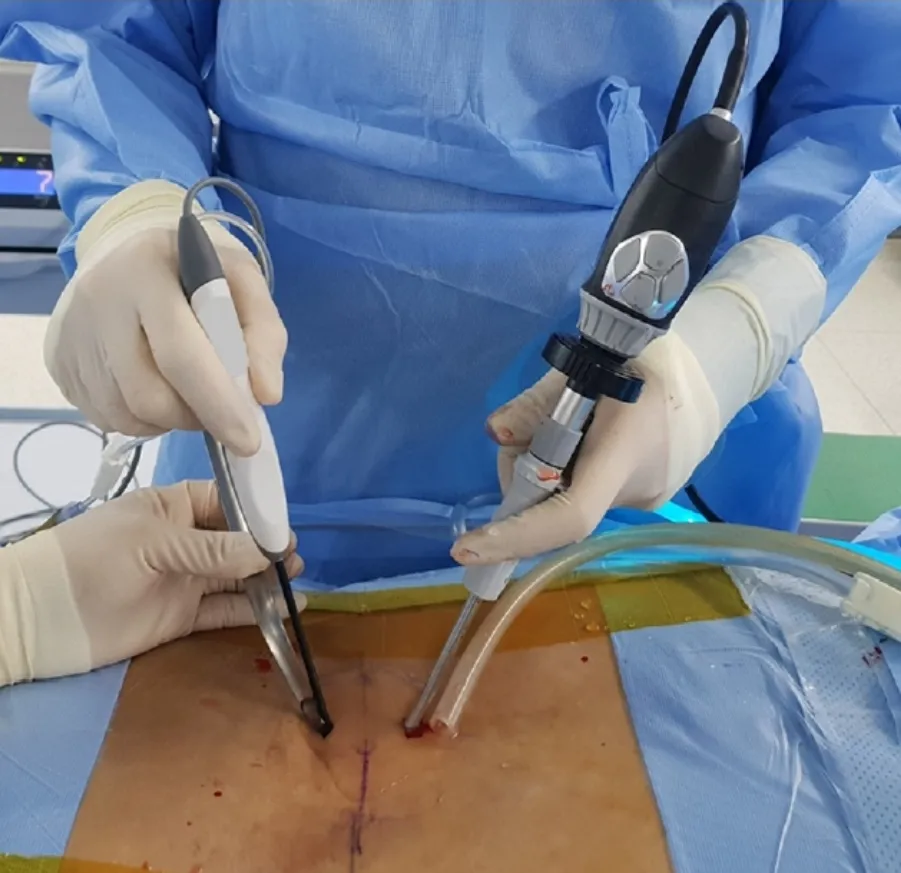
Unilateral biportal endoscopy (UBE) with unilateral laminotomy for bilateral decompression (ULBD) is an essential neurosurgical procedure for the treatment of lumbar spinal stenosis. This technique offers significant advantages over traditional full laminectomy and spinal fusion fixation, providing surgeons with greater operational freedom and precision in decompression. The UBE-ULBD procedure stands out because of its distinct working and observation channels, which significantly augment the surgeon's maneuverability. The process begins by marking two 1-cm incisions, approximately 1 cm away from the midpoint of the cranial and caudal extents at the target intervertebral space, using the intersection of the surgical side's laminar gap with the puncture needle as a central reference. This methodical approach ensures that the bilateral channels are interconnected at the laminar gap. After this, meticulous dissection of the soft tissues encircling the laminar gaps for both channels is performed using specialized separation instruments, guaranteeing a clear passage between the observation and working channels. The endoscope is then meticulously positioned within the left observation channel, integrating it with a light source, high-definition imaging system, and an irrigation line for optimal visualization. On the right side, the working channel is adeptly used with a nucleotome and radiofrequency ablation electrode to meticulously remove soft tissues. This step is crucial for exposing the superior edge of the inferior lamina, the laminar gap itself, and the inferior edge of the superior lamina, thereby achieving effective bilateral decompression.Characterized by minimal incisions and rapid postoperative recovery. The percutaneous endoscopic ULBD offers shorter operative times and less muscle trauma and blood loss, which may have a multifaceted positive impact on postoperative recovery and symptom alleviation for patients.
Lumbar spinal canal stenosis (LSS) is a common spinal degenerative disease in the middle-aged and elderly. The main manifestation is that the waist and legs are sore and painful when walking or standing for a period of time, and they need to rest before they can continue to move. With the progress of the disease, the walking distance is gradually shortened, while the rest time is gradually prolonged. At present, the traditional treatment of lumbar spinal stenosis, such as total laminectomy decompression, semi-laminectomy decompression, all cause some damage to the lamina, and affect the stability of the spine. In addition, intraoperative muscle separation and traction often lead to postoperative low back pain and other complications. In order to reduce the damage to the normal structure of the spine, the attention of spinal surgeons has gradually shifted to minimally invasive surgery. With the continuous innovation of technology, there are microscopic decompression (MD) of spinal canal, percutaneous endoscopic technique, interbody fusion, and other treatment of LSS, all of which have achieved satisfactory results in clinical practice. In the treatment of lumbar spinal stenosis, the traditional laminectomy and decompression surgery will extensively peel off the muscles and destroy the stability of the spine. Patients may have chronic low back pain and secondary instability of the spine after the operation.
The development of the new technique of unilateral biportal endoscopy (UBE) has solved the problems of narrow channel and limited instruments during single-hole endoscopy and microsurgical decompression.
UBE uses water as a medium like a single-channel endoscope, and continuous water irrigation can ensure the clarity of the surgical field. In addition, its visibility is similar to that of a microscope, which can reduce the damage to muscles and other tissues.