Vitamin B12 Rich Foods: Best Sources, and the Truth About B12 in Fruits & Vegetables
Updated on: September 24, 2026 | Medically reviewed by: Dr Dimpi Malik
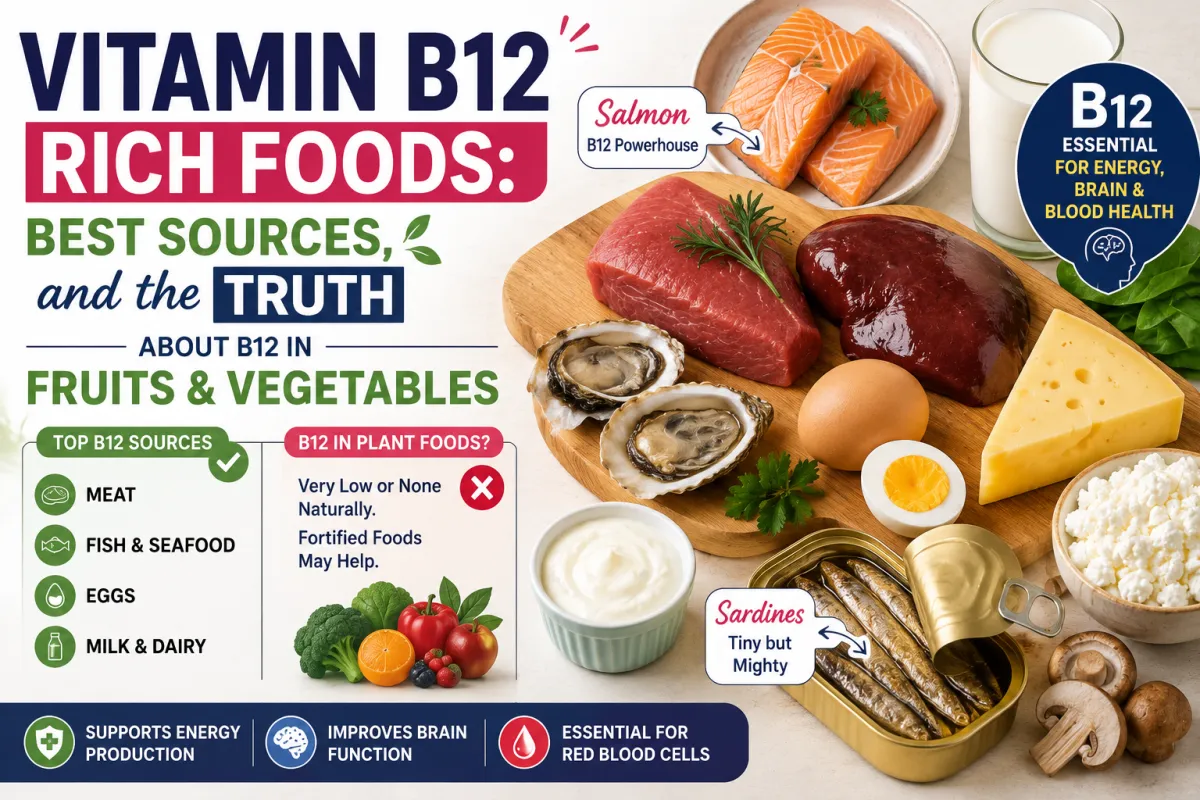
- Vitamin B12 is produced by bacteria, not by plants — this is why no fruit or vegetable naturally contains it, no matter how "nutrient-dense" it is otherwise.
- The richest food for B12 are animal-based: organ meats and shellfish top the list, followed by fatty fish, eggs, and dairy.
- People searching for vitamin B12 vegetables and fruits are usually hoping for a plant-based source — the honest answer is that fortified foods and supplements are the reliable options for vegans, not produce.
- Your body stores 3–5 years' worth of B12 in the liver, so deficiency can develop silently long before symptoms appear.
- Vegans, adults over 50, pregnant/breastfeeding women, and people on certain medications (like metformin or long-term acid-reducers) are the groups most likely to need a fortified source or supplement.
What are the best vitamin B12 rich foods? Clams, beef liver, fatty fish (mackerel, sardines, salmon, tuna), eggs, and dairy products are the most reliable sources of vitamin B12. Fruits and vegetables contain no vitamin B12 at all, since it's a nutrient made by bacteria, not by plants.
1. The One Fact Behind Every B12 Food Myth
If you're searching for the best food for B12 or genuine vitamin B12 rich foods, there's one biological fact worth knowing before anything else: vitamin B12 is synthesized by bacteria — not by plants, and not even by animals themselves. Animals end up with B12 in their tissues because they consume it through bacteria in soil, feed, or their own gut microbiome, which is passed along the food chain.
This single fact explains almost every confusing claim you'll come across when researching vitamin B12 vegetables and fruits online — including why some "superfood" lists get this vitamin wrong.
2. Do Vitamin B12 Vegetables and Fruits Actually Exist?
Quick answer: No. Fruits and vegetables contain 0 mcg of vitamin B12. This isn't a matter of "low amounts" — plants cannot synthesize this vitamin at all, regardless of how nutritionally rich they are in other areas.
Searches like "b12 in fruits and veggies," "vitamin b12 foods fruit," or "fruit with vitamin b12" are common, and understandably so — people want an easy, plant-based answer. But if a food list includes bananas, spinach, oranges, or any other produce as a vitamin B12 source, it's either confusing general nutrition with this one specific vitamin, or it's simply inaccurate.
The exceptions people often bring up — spirulina and seaweed — mostly contain B12 analogues, molecules that resemble B12 in a lab test but don't function the same way in the body. Some research even suggests these analogues may interfere with the absorption of real B12. Relying on them as a primary source can leave a plant-based diet deficient without any obvious warning for years.
3. Vitamin B12 Rich Foods: The Full List
The table below lists common vitamin B12 rich foods by approximate content per standard serving, based on general USDA nutrition data. The adult RDA for vitamin B12 is 2.4 mcg/day.
| Food | Serving | Approx. B12 | Approx. % Daily Value |
|---|---|---|---|
| Clams (cooked) | 3 oz | ~84 mcg | ~3,500% |
| Beef liver (cooked) | 3 oz | ~70 mcg | ~2,900% |
| Octopus | 3 oz | ~30 mcg | ~1,275% |
| Oysters | 3 oz | ~24 mcg | ~1,000% |
| Mackerel / Sardines | 100g | ~9–11 mcg | ~375–460% |
| Trout | 3 oz | ~5.4 mcg | ~225% |
| Salmon | 100g | ~3.2 mcg | ~130% |
| Tuna | 3 oz | ~2.5 mcg | ~105% |
| Beef | 3 oz | ~1.5–2.3 mcg | ~65–95% |
| Fortified plant milk | 1 cup | ~1–3 mcg* | ~40–125%* |
| Cow's milk | 1 cup | ~1.1–1.2 mcg | ~50–60% |
| Yogurt | 1 cup | ~1.1 mcg | ~45% |
| Egg (large) | 1 egg | ~0.6 mcg | ~25% |
| Chicken | 3 oz | ~0.3 mcg | ~13% |
| Any fruit or vegetable | Any | 0 mcg | 0% |
*Fortified milk/cereal content varies significantly by brand — always check the nutrition label.
4. Find the Right B12 Foods for Your Situation
Instead of a one-size-fits-all list, here's what the evidence generally supports for different groups looking for food for B12:
You eat meat, fish, eggs, or dairy regularly
You're likely covering your needs already. Even one weekly serving of clams or beef liver comfortably covers your weekly requirement, and fatty fish, eggs, and dairy round out reliable everyday intake.
You're vegetarian (dairy/eggs, no meat or fish)
You're in a reasonably safe position. Milk, yogurt, cheese, and eggs are legitimate, sufficient sources — supplementation usually isn't necessary, though it's worth confirming with a blood test if you eat these infrequently.
You're vegan (no animal products at all)
This is the group with real risk, and the one most likely to search for vitamin B12 vegetables and fruits hoping for an easy plant-based answer. There is no reliable whole-food plant source of B12. Dependable vegan-friendly options include:
- Fortified plant milk or breakfast cereal (check the label — fortification varies by brand)
- Nutritional yeast, but only if it's specifically labeled as B12-fortified
- A B12 supplement — considered by most dietitians to be the safest, most reliable option for strict vegans
You're over 50
Even with animal products in your diet, your risk rises with age. A meaningful share of older adults develop reduced stomach acid production, which lowers the body's ability to absorb B12 from food. Many clinicians recommend fortified foods or a supplement in this age group rather than relying solely on food-bound B12.
You're pregnant or breastfeeding
Requirements are higher than the standard adult RDA — around 2.6 mcg/day during pregnancy and 2.8 mcg/day while breastfeeding — since B12 supports fetal and infant neurological development. Discuss with your obstetrician whether your prenatal vitamin already covers this.
You're on metformin or a long-term acid-reducing medication (PPI)
Both are recognized to interfere with B12 absorption over time. If you're on either long-term, ask your doctor about periodic B12 testing, even without symptoms.
5. Daily Vitamin B12 Requirement by Age
| Age/Group | Approximate Daily Requirement |
|---|---|
| Infants (0–12 months) | 0.4–0.5 mcg |
| Children (1–13 years) | 0.9–1.8 mcg |
| Teens & Adults (14+ years) | 2.4 mcg |
| Pregnant women | ~2.6 mcg |
| Breastfeeding women | ~2.8 mcg |
These are general population guidelines. Individual needs can vary based on absorption issues, medications, and existing health conditions — a doctor can advise on your specific requirement.
6. Signs of Vitamin B12 Deficiency
Deficiency symptoms build gradually, which is exactly why they're easy to mistake for something else:
- Fatigue that doesn't improve with rest
- Tingling or numbness in the hands and feet
- Trouble with balance or coordination
- Memory lapses or difficulty concentrating
- A sore, unusually red or smooth tongue
- Pale or slightly yellow-tinted skin
None of these symptoms are exclusive to B12 deficiency, which is exactly why a blood test — not symptom-matching — is the only reliable way to confirm it. Since the liver can store several years' worth of B12, levels can already be declining well before any of these signs appear.
7. Common Myths About B12 Foods, Fact-Checked
Fact: They contain 0 mcg — B12 cannot be produced by any plant, regardless of how nutrient-dense it is otherwise.
Fact: They mostly contain inactive B12 analogues that don't function the same way in the body, and may even interfere with real B12 absorption.
Fact: The liver stores 3–5 years' worth of B12, but that's a buffer, not a lifetime supply — stores deplete once intake or absorption drops.
Fact: Since B12 is water-soluble, excess is excreted rather than stored, so megadosing isn't harmful — but it also isn't more beneficial past what the body can absorb.
Fact: Because of the liver's long-term reserve, levels can be declining well before any symptoms appear — feeling fine doesn't rule out early deficiency.
Fact: Nutritional yeast is typically fortified with real, functional B12 during production, while spirulina naturally contains mostly inactive analogues — always check the label.
Fact: Fortification levels vary significantly by brand, so checking the nutrition label is the only way to know.
Fact: Older adults, people on certain medications, and those with absorption issues can also be at risk, even if they eat animal products.
8. Tips to Preserve B12 When Cooking
- High heat can degrade 30–50% of the B12 content in shellfish and organ meats — steaming, baking, or a quick sauté preserves more than prolonged boiling or frying.
- If cooking clams or other shellfish in liquid, keep the broth, since B12 leaches into it during cooking.
- Avoid overcooking eggs at very high heat for extended periods, as this can also reduce B12 content slightly.
9. When to See a Doctor
Consider getting a B12 blood test if you:
- Follow a vegan diet without a reliable fortified source or supplement
- Are over 50, especially with digestive symptoms
- Are pregnant or breastfeeding and unsure if your prenatal vitamin covers B12
- Are on long-term metformin or acid-reducing medication
- Experience persistent fatigue, tingling in the hands/feet, or memory difficulties
If you have any of these risk factors or symptoms, consult a doctor at Nova Hospital Meerut for proper testing and guidance rather than self-diagnosing based on symptoms alone.
References
- National Institutes of Health, Office of Dietary Supplements. Vitamin B12 — Fact Sheet for Health Professionals .
- National Institutes of Health, Office of Dietary Supplements. Vitamin B12 — Fact Sheet for Consumers .
- U.S. Department of Agriculture. FoodData Central .
- National Academies of Sciences, Engineering, and Medicine. Dietary Reference Intakes for Thiamin, Riboflavin, Niacin, Vitamin B6, Folate, Vitamin B12, Pantothenic Acid, Biotin, and Choline. Washington, DC: National Academy Press.