Vitamin D Deficiency: Symptoms, Causes, Treatment & Prevention
Updated on: October 15, 2026 | Medically reviewed by: Dr. Vikrant Solanki
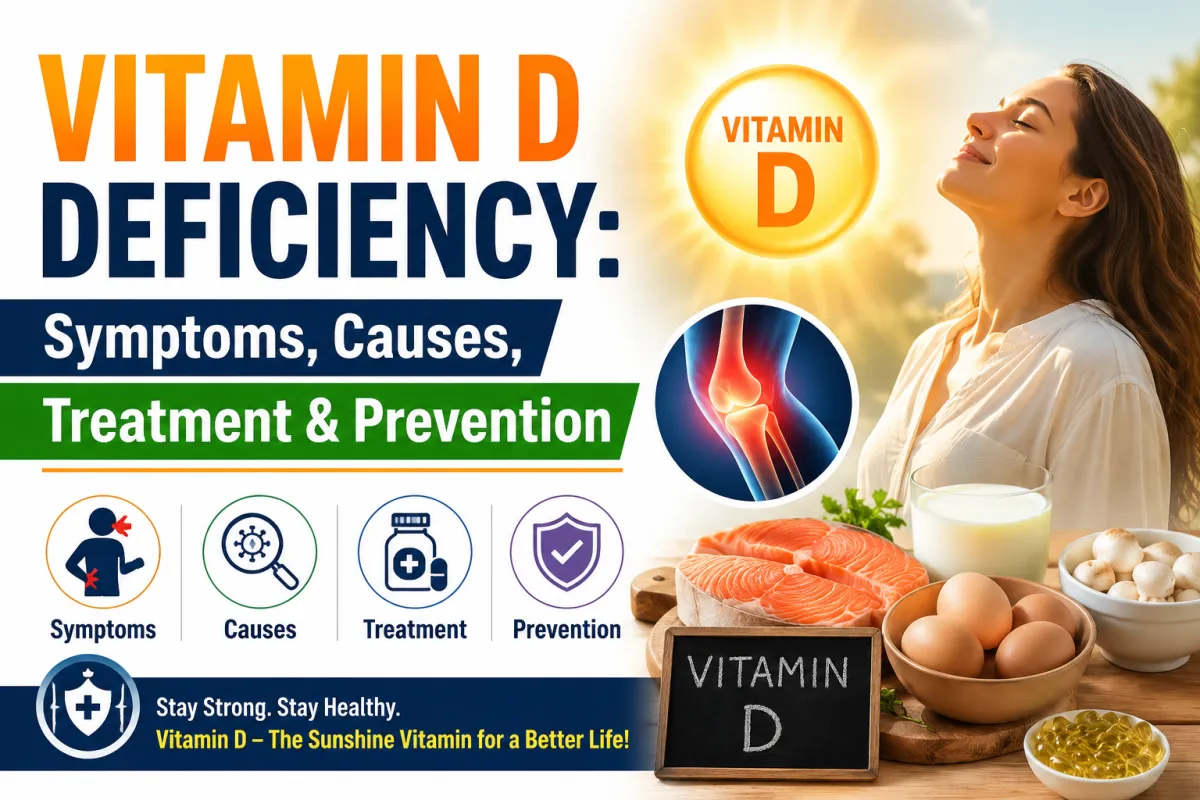
If you have been feeling unusually tired, achy, or low despite a normal blood sugar and thyroid report, low Vitamin D could be the missing piece. It is one of the most common — and most commonly missed — nutritional deficiencies seen in Indian outpatient clinics today, and the good news is that it is simple to test for and, in most cases, straightforward to treat.
Vitamin D deficiency has quietly become a nationwide health concern. Large-scale laboratory data collected across India shows that nearly 7 in 10 Indians tested have either deficient or insufficient Vitamin D levels, even though the country receives abundant sunshine almost all year round. That may sound surprising, but the explanation is simple: modern indoor lifestyles, desk jobs, pollution, sunscreen use, and skin covered by clothing all block the skin from making vitamin D, no matter how sunny it is outside.
This guide explains, in plain language, what Vitamin D deficiency is, its early and advanced symptoms, who is most at risk, how it is diagnosed, and how it is treated and prevented — so you know exactly what to look out for and when to get checked.
What Is Vitamin D and Why Is It Important?
Vitamin D is often called the "sunshine vitamin" because your skin makes it when exposed to sunlight. Technically, it behaves less like a typical vitamin and more like a hormone — once activated, it travels through the bloodstream and switches genes on or off in cells throughout the body.
Its best-known job is helping your intestines absorb calcium and phosphorus, which is why it is so closely tied to bone health. But Vitamin D receptors are found in muscle, immune cells, the brain, the heart, and many other tissues, which is why deficiency can show up as such a wide, sometimes confusing, range of symptoms.
How your body makes and processes Vitamin D
- Skin synthesis: UVB rays convert a cholesterol compound in your skin into pre-vitamin D3.
- Liver conversion: The liver converts this into 25-hydroxyvitamin D, or 25(OH)D — the form measured in a blood test.
- Kidney activation: The kidneys convert it further into the active hormone, calcitriol, which does the actual work in the body.
- Dietary route: Vitamin D from food or supplements (D2 or D3) enters the same liver-to-kidney conversion pathway.
Normal Vitamin D Range and Deficiency Levels
Vitamin D status is measured using a blood test for 25-hydroxyvitamin D, written as 25(OH)D. Most Indian laboratories and hospitals, including Nova Hospital Meerut's pathology department, report results in nanograms per millilitre (ng/mL) and classify them as follows:
| Category | 25(OH)D Level (ng/mL) | 25(OH)D Level (nmol/L) | What it means |
|---|---|---|---|
| Deficient | Below 20 | Below 50 | Bone and muscle health may be affected; treatment usually recommended |
| Insufficient | 20 – 29 | 50 – 72 | Below optimal; often needs diet, sun, or supplement correction |
| Sufficient | 30 – 100 | 75 – 250 | Generally adequate for most healthy adults |
| Potentially toxic | Above 100 | Above 250 | Risk of excess calcium; needs medical review |
What Is Vitamin D Deficiency Disease?
Before food fortification and supplements became common, severe Vitamin D deficiency disease was a major public health problem worldwide. Today, severe rickets is less common, but mild to moderate deficiency remains extremely widespread — and it still carries real, measurable health consequences, especially when it persists for months or years without treatment.
Signs and Symptoms of Vitamin D Deficiency
Vitamin D deficiency develops slowly, so symptoms are often subtle at first and easy to dismiss as "just being tired" or "getting older." Recognising the pattern early can help you get tested sooner.
Early symptoms
- Persistent fatigue or low energy, even after adequate sleep
- Generalised body ache or dull muscle soreness
- Low mood or irritability
- Getting colds, flu, or infections more often than usual
- Hair thinning or increased hair fall
- Slow wound healing
Advanced or long-standing symptoms
- Bone pain, especially in the lower back, hips, pelvis, and legs
- Muscle weakness, particularly in the thighs, making stairs or standing up from a chair harder
- Increased risk of falls, especially in older adults
- Bone fractures with minimal trauma
- Bone deformities in children (bowed legs, delayed growth)
- Tingling or numbness, in rare cases linked to low calcium
| Symptom | Why it happens |
|---|---|
| Fatigue | Vitamin D receptors affect mitochondrial energy production in cells |
| Bone pain | Poor calcium absorption leads to under-mineralised, softer bone |
| Muscle weakness | Vitamin D supports muscle fibre function and strength |
| Frequent infections | Vitamin D helps regulate immune cell activity |
| Low mood | Vitamin D receptors are present in mood-regulating brain regions |
| Hair thinning | Vitamin D supports the hair follicle growth cycle |
Symptoms in women
Women, particularly after menopause, are at higher risk of both Vitamin D deficiency and osteoporosis together, which compounds fracture risk. Women may also notice a link between low Vitamin D and worsened PMS symptoms, irregular cycles, or fatigue that is sometimes mistaken for iron deficiency alone.
Symptoms in men
In men, deficiency more often presents as muscle weakness, reduced stamina during exercise, and general fatigue. Some research has explored a link between low Vitamin D and lower testosterone levels, though this connection is still being studied and is not yet considered conclusive.
Symptoms in children
Watch for delayed walking, bowed legs or knock-knees, soft skull bones in infants (craniotabes), dental delays, and slow growth. Severe deficiency in children can lead to rickets, which needs prompt paediatric evaluation.
Symptoms in older adults
Older adults may present primarily with falls, unexplained bone pain, or a fracture after a minor fall. Because skin becomes less efficient at making Vitamin D with age, and outdoor activity often reduces, this age group is at particularly high risk.
Vitamin D deficiency during pregnancy
Pregnant women need Vitamin D for both their own bone health and their baby's skeletal development. Observational studies link deficiency during pregnancy with a higher risk of gestational diabetes, pre-eclampsia, and low birth weight, which is why most obstetricians, including at Nova Hospital Meerut, include Vitamin D screening as part of routine antenatal check-ups.
Vitamin D Deficiency Causes and Risk Factors
Vitamin D deficiency is rarely caused by just one factor — it is usually a combination of lifestyle, geography, and biology.
| Risk Factor | Why It Increases Risk |
|---|---|
| Limited sun exposure | Desk jobs, indoor lifestyles, and commuting in covered vehicles reduce skin's UVB exposure |
| Darker skin tone | Higher melanin content reduces the skin's efficiency at making Vitamin D from a given amount of sunlight |
| Air pollution | Smog and particulate matter scatter and block UVB rays, common in North Indian cities in winter |
| Sunscreen and full-body clothing | Both physically block the UVB rays needed for skin synthesis |
| Obesity | Vitamin D is fat-soluble and gets sequestered in fat tissue, lowering blood levels |
| Older age | Skin becomes less efficient at Vitamin D synthesis; outdoor activity often decreases |
| Exclusive breastfeeding without supplementation | Breast milk alone is typically low in Vitamin D |
| Malabsorption disorders (celiac disease, Crohn's disease, chronic pancreatitis) | Reduced fat absorption in the gut impairs Vitamin D absorption from food |
| Kidney or liver disease | Both organs are required to convert Vitamin D into its active form |
| Certain medications (steroids, anti-seizure drugs, some HIV medications) | Can speed up the breakdown of Vitamin D in the body |
| Vegan or strict vegetarian diet | Fewer natural dietary sources compared to non-vegetarian diets |
| Living at higher latitudes or in winter months | Weaker or more angled sunlight reduces UVB availability |
Who is at the highest risk?
- Older adults (65+), especially those who are largely housebound
- Pregnant and breastfeeding women
- Infants who are exclusively breastfed without supplement drops
- People with darker skin living in temperate regions
- Office workers with minimal outdoor time
- People with obesity
- Anyone with a chronic gut, liver, or kidney condition
- People who cover most of their skin for religious, cultural, or occupational reasons
Conditions Linked to Vitamin D Deficiency
Left untreated, chronic Vitamin D deficiency has well-established effects on bone and muscle health, and is an active area of research for several other conditions.
Well-established effects
- Osteomalacia: softening of bones in adults due to poor mineralisation
- Rickets: soft, weakened, and bowed bones in growing children
- Osteoporosis: deficiency accelerates bone density loss, particularly alongside low calcium intake
- Secondary hyperparathyroidism: the body pulls calcium from bone to compensate, weakening it further
- Muscle weakness and falls: especially significant in older adults, raising fracture risk
Areas of ongoing research
Observational studies have associated low Vitamin D with immune function, mood, cardiovascular health, insulin resistance and type 2 diabetes, autoimmune conditions, and certain cancers. However, well-designed clinical trials have not consistently proven that supplementation prevents these conditions in the general population, which is why the 2024 Endocrine Society guideline specifically limits its disease-prevention recommendations to a few defined groups rather than the public at large. This is a genuinely evolving area of medicine, and it is best discussed individually with your doctor rather than assumed from headlines.
Diagnosis: The Vitamin D Test
Diagnosing Vitamin D deficiency is straightforward and does not require fasting.
- Test name: Serum 25-hydroxyvitamin D, or 25(OH)D
- Sample: A single blood draw
- Turnaround: Usually same-day to 48 hours, depending on the lab
- Preparation: No fasting required in most cases
| Test | What It Measures | When It's Used |
|---|---|---|
| 25(OH)D (main test) | Total body Vitamin D stores | Standard screening and diagnosis |
| 1,25-dihydroxyvitamin D | Active hormone form | Only in specific kidney or calcium disorders, not for routine screening |
| Serum calcium and phosphorus | Related mineral levels | Ordered alongside Vitamin D if bone disease is suspected |
| Parathyroid hormone (PTH) | Compensatory hormone response | When deficiency is severe or bone symptoms are present |
| Bone density scan (DEXA) | Bone strength and fracture risk | In long-standing deficiency or postmenopausal women |
Vitamin D Deficiency Treatment
Treatment is generally very effective and tailored to how low your level is, your age, and the underlying cause.
Vitamin D2 vs Vitamin D3
| Feature | Vitamin D2 (Ergocalciferol) | Vitamin D3 (Cholecalciferol) |
|---|---|---|
| Source | Plant and fungal (yeast, mushrooms) | Animal-derived or lab-synthesised; the same form your skin makes |
| Effectiveness at raising blood levels | Generally less potent | Generally more effective and longer-lasting |
| Suitable for vegans | Yes | Traditionally animal-derived, though lichen-derived vegan D3 is now available |
| Common use | Some prescription formulations | Most over-the-counter supplements |
Treatment approaches
- Oral supplements: The most common route — daily, weekly, or monthly dosing, exactly as prescribed by your doctor based on your blood level.
- High-dose correction therapy: For diagnosed deficiency, doctors often prescribe a higher weekly or monthly dose for 6 to 12 weeks, followed by a lower daily maintenance dose.
- Injection: In select cases, such as malabsorption disorders, a doctor may recommend an intramuscular Vitamin D injection instead of oral therapy.
- Dietary changes: Adding Vitamin D-rich and fortified foods to your daily diet.
- Sensible sun exposure: Regular, moderate, unprotected sun exposure as a natural, low-cost source.
Can Vitamin D deficiency be cured?
Yes — in the vast majority of cases, Vitamin D deficiency is fully correctable with the right combination of supplements, diet, and sun exposure. It usually is not a one-time fix, though; because lifestyle factors caused the deficiency in the first place, ongoing maintenance through diet, sunlight, or a low-dose supplement is often needed to keep levels from dropping again.
Recovery timeline
| Timeframe | What to Expect |
|---|---|
| 2 – 4 weeks | Blood levels begin rising; some people notice early improvement in energy |
| 8 – 12 weeks | Blood levels typically normalise with correct dosing; repeat test usually done here |
| 3 – 6 months | Bone pain and muscle weakness usually show meaningful improvement |
| Ongoing | Maintenance dose or lifestyle changes to prevent relapse |
Vitamin D Rich Foods
Very few foods naturally contain significant Vitamin D, which is exactly why sunlight and fortified foods matter so much.
| Food | Type | Approx. Vitamin D (per typical serving) |
|---|---|---|
| Fatty fish (salmon, mackerel/bangda, sardines) | Non-vegetarian | High — among the richest natural sources |
| Fish liver oil (cod liver oil) | Non-vegetarian | Very high, even in small amounts |
| Egg yolk | Ovo-vegetarian / Non-vegetarian | Low to moderate per yolk |
| Mushrooms exposed to UV light | Vegetarian | Moderate to high, varies by product |
| Fortified milk and curd | Vegetarian | Moderate; check the label for exact IU |
| Fortified edible oil (as per India's food fortification programme) | Vegetarian | Moderate; varies by brand |
| Fortified breakfast cereals | Vegetarian | Low to moderate |
| Liver (chicken or mutton) | Non-vegetarian | Low to moderate |
Sample Indian diet additions
- Vegetarian: fortified milk with breakfast, a handful of UV-exposed mushrooms in sabzi, fortified oil for cooking
- Non-vegetarian: oily fish such as bangda or sardines twice a week, eggs with the yolk included
- Everyone: 15–30 minutes of midday sun exposure, several times a week, alongside diet
Sunlight Exposure Guide
| Factor | General Guidance |
|---|---|
| Best time of day | Late morning, roughly 11 am – 1 pm, when UVB rays are strongest |
| Duration | Approximately 15–30 minutes, several times a week, adjusted for skin tone |
| Body area | Arms, legs, or back exposed; face alone is often not enough surface area |
| Sunscreen | Blocks UVB and reduces synthesis; brief unprotected exposure is typically recommended before applying sunscreen for longer outdoor time |
| Darker skin tones | May need longer exposure time to make the same amount of Vitamin D |
| Through glass | Not effective — window glass blocks UVB rays |
| Winter / high pollution days | Reduced UVB availability; dietary sources and supplements become more important |
Daily Vitamin D Requirement and Prevention
| Age Group | Recommended Daily Allowance |
|---|---|
| Infants (0–12 months) | 400 IU (10 mcg) |
| Children and teens (1–18 years) | 600 IU (15 mcg) |
| Adults (19–70 years) | 600 IU (15 mcg) |
| Adults (70+ years) | 800 IU (20 mcg) |
| Pregnant and breastfeeding women | 600 IU (15 mcg), though doctors may recommend higher amounts based on blood levels |
Prevention checklist
- Get 15–30 minutes of direct midday sun several times a week
- Include Vitamin D-rich or fortified foods in your regular diet
- Get tested if you belong to a high-risk group, rather than waiting for symptoms
- Maintain a healthy body weight
- Discuss a low-dose maintenance supplement with your doctor if your lifestyle is largely indoors
- Ensure infants and young children receive paediatrician-recommended Vitamin D drops
- Re-test periodically if you have a chronic condition affecting absorption
Myths vs Facts
| Myth | Fact |
|---|---|
| India is sunny, so Indians can't be Vitamin D deficient | Studies show a majority of Indians tested have deficient or insufficient levels, largely due to indoor lifestyles and limited direct sun exposure |
| Sitting near a window gets you enough sun | Window glass blocks the UVB rays needed for skin synthesis |
| More Vitamin D is always better | Excess supplementation can raise blood calcium to unsafe levels; more is not automatically better |
| Only bones are affected by low Vitamin D | Muscles, immune function, and possibly mood are also affected, alongside bone health |
| Milk alone guarantees enough Vitamin D | Only fortified milk contains meaningful amounts, and even then, usually not enough on its own |
| You'll always feel symptoms if you're deficient | Many people with low levels have no obvious symptoms until it becomes more advanced |
When Should You See a Doctor?
Book a consultation if you notice:
- Persistent, unexplained fatigue or weakness
- Bone pain, especially in the back, hips, or legs
- Frequent infections or slow-healing wounds
- Muscle cramps, tingling, or difficulty climbing stairs
- You belong to a high-risk group: pregnant, over 65, obesity, chronic kidney or liver disease, or a malabsorption disorder
- A recent fracture from a minor fall
How Nova Hospital Meerut Can Help
Nova Hospital & Research Centre, Meerut, offers on-site pathology testing for Vitamin D and related bone health markers, along with consultations across Internal Medicine, Orthopedics, Obstetrics & Gynaecology, and Pediatrics for age-appropriate diagnosis and treatment. If you recognise any of the symptoms above, our team can arrange a Vitamin D test and a personalised treatment plan, taking into account your age, lifestyle, and any existing health conditions.
Key Takeaways
- Vitamin D deficiency is extremely common in India, affecting a majority of people tested, despite abundant sunshine
- Early symptoms — fatigue, low mood, body ache, frequent infections — are easy to mistake for other causes
- A single blood test (25-hydroxyvitamin D) confirms the diagnosis
- Treatment usually combines supplements, diet, and sensible sun exposure, and is highly effective
- High-dose supplements should always be taken under medical supervision, not self-prescribed
- Prevention is simple: regular midday sun, Vitamin D-rich foods, and periodic testing if you're at higher risk
Further reading (external, authoritative sources):
- NIH Office of Dietary Supplements — Vitamin D Fact Sheet: ods.od.nih.gov/factsheets/VitaminD-Consumer
- Endocrine Society — Vitamin D for the Prevention of Disease, 2024 Clinical Practice Guideline: endocrine.org/clinical-practice-guidelines
- Cleveland Clinic — Vitamin D, Vitamin D Deficiency: my.clevelandclinic.org
- Mayo Clinic — Vitamin D: mayoclinic.org
- NCBI/PubMed — Vitamin D deficiency in India, systematic reviews